


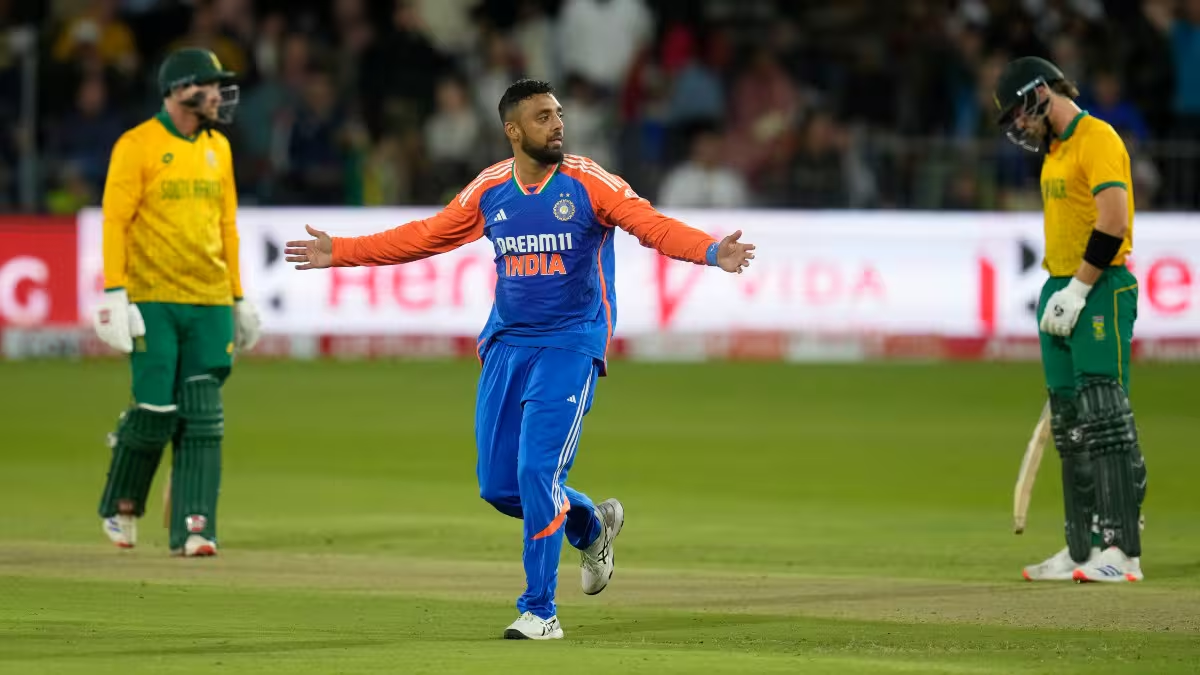
Cricket is a sport built on rivalries — some legendary, some subtle, and some fascinatingly unexpected. Among the many duels that have shaped modern T20 cricket, none have been quite as statistically surprising as this one: Reeza Hendricks averages just 1.66 against Varun Chakravarthy in T20Is.
This isn’t merely a trivia fact. It is a micro-story within the larger narrative of India-South Africa cricket. It hints at deeper themes: matchup strategy, batter weaknesses, bowler deception, and the chess-like mind games of T20 cricket.
In a format where batters often dominate, and where openers like Hendricks are expected to set blazing tempos, being consistently undone by the same bowler across multiple matches is a rarity — and a point of curiosity.
This article breaks down every element of this matchup:
- The raw numbers,
- The ball-by-ball dynamics,
- The psychology behind repeated dismissals,
- How Chakravarthy’s variations specifically exploit Hendricks’ technique,
- The future implications for South Africa and the T20 landscape.
The Stat That Sparked the Discussion

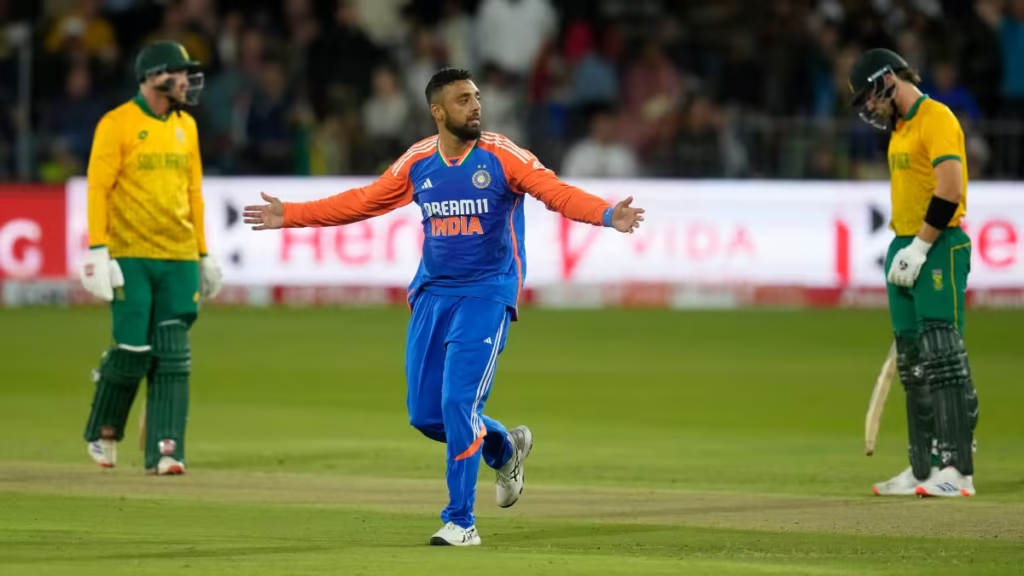
Let’s begin with the cold, hard numbers recorded in their head-to-head T20I matchups.
Across their meetings so far:
- Innings faced: 3
- Balls faced: 7
- Runs scored: 5
- Times dismissed: 3
- Batting average: 1.66
- Strike rate: 71.42
These numbers reveal three crucial things:
Hendricks has been unable to survive Chakravarthy’s spells.
Three dismissals in three attempts tell us this is not random. Bowlers don’t get top-order batters out every single time unless a distinct pattern exists.
He hasn’t had time to settle at the crease.
Facing only seven balls across multiple matches shows Hendricks rarely gets to rotate strike or build rhythm.
The scoring rate is uncharacteristically low.
With a career T20I strike rate over 125, Hendricks’ scoring at 71 indicates he’s not reading Chakravarthy well enough to take low-risk singles.
This leaves us with a simple but intriguing fact:
This is one of the most one-sided matchups in modern T20 cricket.
Match-by-Match Breakdown

To understand why this average has dropped so low, we must revisit each match where Chakravarthy dismissed Hendricks.
The 2021 Encounter: The First Warning Sign
In their earliest T20I meeting, Hendricks attempted to counter Varun Chakravarthy by coming down the track. The idea was sound — disrupt the bowler, unsettle his length, and negate his variations.
But Chakravarthy anticipated this and bowled a drifting, flatter ball that cramped Hendricks for room. The result? A mis-timed stroke and a regulation catch.
This dismissal set the tone. Hendricks didn’t decode Chakravarthy’s bowling — and Chakravarthy gained confidence.
India vs South Africa, 2025 Series — Mullanpur
This series was where the stat truly exploded in relevance.
Second T20I (December 11, 2025)
South Africa were under pressure early when Hendricks walked out. India knew the matchup advantage and introduced Chakravarthy early.
On his very first delivery to Hendricks, Chakravarthy bowled a carrom ball that drifted late and skidded off the pitch. Hendricks, attempting a pull shot to break free, completely misread the length.
The T20I battle between Varun Chakravarthy and South African opener Reeza Hendricks continues to heavily favor the Indian spinner. Hendricks has faced Chakravarthy in three T20I innings and has been dismissed by him in all three, resulting in a historically poor T20I average of just 1.66 for Hendricks in this specific match-up. For Hendricks to turn the tide, he must find a way to counter the deceptive pace and skid of the spinner’s carrom ball, a delivery that has consistently exposed a technical flaw in Hendricks‘ defense. The next encounter is crucial for Hendricks to regain form and confidence against India.
The ball sneaked under the bat and hit the stumps.
Dismissal again.
Average dips again.
Headline writes itself again.
Hendricks looked visibly frustrated, while Chakravarthy celebrated calmly, knowing the pattern had held firm.
Third T20I — The Pattern Becomes Official

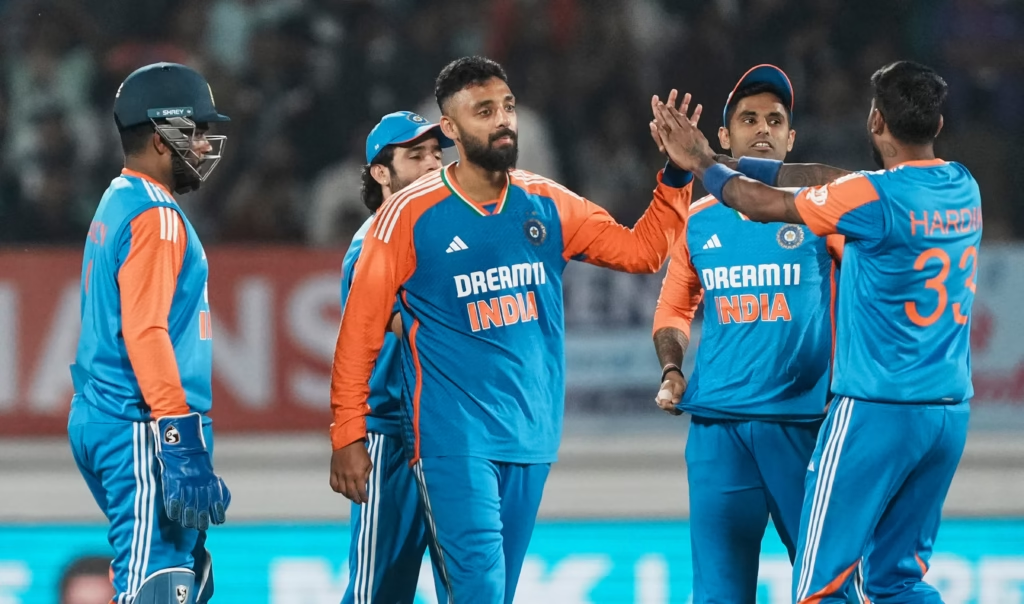
In the final match of the series, things got worse. Hendricks looked desperate to break the narrative and tried aggressive footwork against Chakravarthy.
But once more, Chakravarthy’s control over flight and length cornered him. A mistimed cover drive found the fielder.
Three matches.
Three wickets.
Seven balls.
Five runs.
At this point, what was a quirk became a verified pattern.
Technical Breakdown — Why Hendricks Struggles
Understanding the stat requires dissecting technique, footwork, and shot selection.
Here’s the in-depth technical explanation:
Hendricks plays with a high backlift.
While this allows for fluent stroke-play on true pitches, it makes him susceptible to skidding deliveries, especially the type Chakravarthy specialises in.
When the ball arrives quicker and lower than expected, Hendricks struggles to bring the bat down in time.
Chakravarthy’s release point confuses Hendricks.
Varun Chakravarthy doesn’t release the ball like traditional leg spinners or off spinners. His hand position often disguises whether the ball will:
- spin in,
- spin away,
- hold its line, or
- skid straight on.
Against most bowlers, Hendricks reads the wrist or the finger position early. Against Chakravarthy, that early cue does not exist.


The carrom ball is Hendricks’ kryptonite.
The ball that dismissed Hendricks in 2025 was the perfect example.
A carrom ball, when bowled well:
- Looks like a regular delivery,
- but moves only after pitching,
- and can dip unexpectedly.
Hendricks played it like a short ball. It was not.
Hendricks’ front-foot approach makes him vulnerable.
Hendricks prefers to play spinners off the front foot whenever possible. Against someone who varies in length subtly, this becomes risky.
Chakravarthy uses micro-length variations — sometimes just 6–8 inches — to lure batters into misjudgment.
Hendricks repeatedly falls for this trap.
Chakravarthy bowls stump-to-stump.
This is the ultimate reason the average is so low.
Because Chakravarthy attacks the stumps relentlessly, Hendricks has to play every ball. There are no leave options. No breathing space.
When every ball asks a question, the margin for error narrows drastically.
Comparing This Rivalry to Historic Ones
Cricket has seen iconic mismatches before:
- McGrath vs Lara (early years) — Lara initially struggled.
- Shane Warne vs Daryll Cullinan — A mental battle.
- Bumrah vs Finch — Repeated outs in early overs.
- Shadab Khan vs Glenn Maxwell — A rare spin weakness.
But the Hendricks–Chakravarthy matchup stands out because:
- It is a pure T20 anomaly.
- It spans multiple series.
- The dismissals happen immediately.
- The numbers are staggeringly low (1.66 to be exact).
This makes it one of the sharpest matchup-driven imbalances in recent T20 history.
What South Africa Should Do


If South Africa wants to fix this issue, here are strategic options:
Let Hendricks avoid Chakravarthy
Rotate strike aggressively early. The plan:
Get Hendricks off strike immediately.
Send in a left-hander
Left-handers generally read Chakravarthy better due to the angle.
Train Hendricks specifically against carrom-ball bowlers
Simulate Chakravarthy’s action in nets using:
- bowling machines with spin modules,
- wrist-spinners simulating carrom-release,
- video study of Chakravarthy’s wrist position.
Encourage low-risk rotation rather than boundary attempts
Singles break psychological pressure. Lack of rotation builds it.
What India Gains From This Matchup
For India, this rivalry is a tactical asset:
- It gives them a free wicket option against South Africa.
- It boosts Chakravarthy’s confidence.
- It strengthens India’s middle-overs bowling structure.
- It allows India to control Powerplay transitions.
Coaches love predictable matchups — and this is as predictable as it gets.
What the Future Holds
Will Hendricks break this cycle?
Or will Chakravarthy continue dominating this duel?
Possible outcomes:
- Hendricks eventually cracks the code
Batters evolve. He only needs one good innings to reset the psychological narrative. - Chakravarthy continues dominating
If he dismisses Hendricks again, this becomes one of the most lopsided bowler-vs-batter records ever. - South Africa reshuffles their batting order
If the trend continues, they may shield Hendricks early.
Why This Story Matters in T20 Cricket

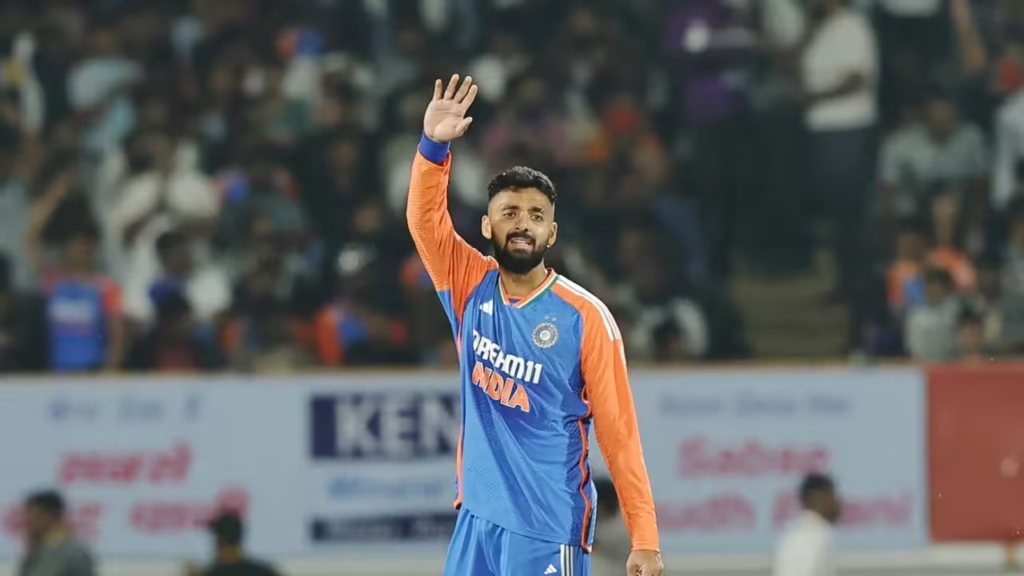
T20 cricket is increasingly a format of matchups, not just talent.
Teams like:
- India,
- Australia,
- England,
- Sunrisers,
- KKR,
- CSK
…have built bowling plans around these micro-rivalries.
This Hendricks–Chakravarthy pattern is the perfect example:
A single matchup can control a phase of play.
That’s why analysts love these numbers.
The highly anticipated duel in T20 Internationals continues, with South African opener Reeza Hendricks struggling immensely against the mystery spin of Varun Chakravarthy. Hendricks has been dismissed by the Indian spinner in every T20I innings they have faced, contributing to Hendricks‘ alarming T20I batting average of just 1.66 against him. This continuous domination highlights a significant technical vulnerability for Hendricks against the carrom ball, making the next encounter crucial for Hendricks to prove his mettle.
Conclusion
To conclude, the fact that Reeza Hendricks averages just 1.66 against Varun Chakravarthy is more than a statistical outlier — it is a window into how technique, psychology, skill, and strategy intersect in modern cricket.
It shows:
- The power of deception.
- The importance of matchups.
- Even seasoned batters can struggle if they fail to read variations.
- How bowlers can carve out dominance through subtlety rather than speed.
This matchup will remain one of the most fascinating subplots in future India–South Africa T20 clashes.
Next time Hendricks walks out, and Chakravarthy starts warming up, remember the story behind that 1.66.
He knows it.
Chakravarthy knows it.
Now, so do you.





Leave a ReplyCancel reply