


In a moment that will be etched into Indian cricket history as unprecedented, the fourth Twenty20 International between India and South Africa at Lucknow’s Atal Bihari Vajpayee Ekana Cricket Stadium was abandoned without a single ball being bowled on December 17, 2025. What made this cancellation particularly striking was not just the outcome, but the sheer gravity of the circumstances that forced match officials to make this rare decision. Dense fog enveloped the stadium as floodlights flickered through a thick blanket of smog, making visibility so poor that neither fielders could track a ball in the air nor could umpires ensure the safety of players on the field.
This marked the first occasion in Indian cricket history that a major international match had to be abandoned due to excessive fog, highlighting a critical issue that extends far beyond the realms of sports: the alarming air quality conditions in northern India during the winter months. The abandonment sparked immediate debates about the Indian Cricket Board’s scheduling practices and their accountability towards player welfare, venues, and the cricket fans who had gathered in anticipation of witnessing an exciting T20 encounter.
Background Context: The India vs South Africa Series
The India versus South Africa series had been one of the most engaging bilateral contests of the season, with multiple formats spanning Tests, One Day Internationals, and T20 Internationals. Going into the fourth T20 match, India had established a commanding position in the series, leading 2-1 with the final match scheduled for Ahmedabad just a day after the Lucknow fixture.


India’s cricket team had been on an impressive streak, remaining unbeaten in their last thirteen T20 series, making this series particularly important in the context of preparation for the T20 World Cup scheduled for February-March 2026. The South African side, despite being formidable opponents, was coming into the match having lost the ODI series 2-1 and the Test series 2-0 to the Indians, making this T20 encounter crucial for salvaging some pride in the bilateral engagement.
The Ekana Stadium in Lucknow, a modern 50,000-seater venue, had been selected as the fourth T20I venue, making it a significant fixture on the Indian cricket calendar. However, what organizers and the BCCI had perhaps not adequately anticipated was the severity of the winter fog that characterizes December in northern India—a climatic challenge that would prove insurmountable for match officials and, ultimately, for the continuation of the fixture.
The Day of the Match: What Happened?
The ominous signs began appearing much earlier than the scheduled match timings. Throughout the afternoon of December 17, a thick layer of fog started hovering over the stadium premises. By the time the floodlights were turned on around 5 PM, the haze had already begun creating visibility challenges that would only intensify as the evening progressed.
The match was originally scheduled to commence at 7 PM, with the toss set for 6:30 PM. However, even before these scheduled timings, match officials became aware that conditions were deteriorating rapidly. What followed was an extraordinary display of patience and hope against mounting odds as umpires conducted seven consecutive inspections of the ground between 6:30 PM and 9:30 PM, hoping that visibility would improve.

The accumulation of dense smog significantly reduced visibility to between 50 and 200 metres, making it impossible for fielders to track balls hit high into the air and equally dangerous for players in all positions on the field. Air quality levels in Lucknow remained in the hazardous range, with the Air Quality Index (AQI) crossing 400 throughout the day, turning the stadium into an environment that posed genuine risks to player welfare and safety.
The Inspection Protocol
As each inspection was conducted, it became increasingly evident that natural conditions were not going to improve. BCCI Vice-President and UPCA President Rajiv Shukla personally visited the ground during one of the inspections to assess the situation himself, underscoring the seriousness with which officials were treating the matter. Despite the presence of senior cricket administrators, the verdict remained consistent: the weather was simply not conducive to international cricket.
Both teams initially attempted light warm-ups on the outfield, with players adjusting to the conditions. However, as the fog continued to thicken, even this became inadvisable. Hardik Pandya, India’s star all-rounder, was visibly seen wearing a surgical face mask to protect himself from the toxic air, a poignant image that crystallized the severity of the environmental conditions facing the players.
By approximately 9:30 PM, match officials took the inevitable decision to call off the match entirely. South Africa’s players, who had initially ventured onto the field for their warm-up, had long since returned to their dressing rooms. The stadium, which had been packed with eager fans anticipating an exciting T20 encounter, was left with a sense of profound disappointment and frustration.
Why Was The Match Cancelled? Understanding the Science Behind The Decision


The decision to abandon an international cricket match is extraordinarily rare and is never taken lightly by match officials. The cancellation in Lucknow occurred because the visibility conditions had deteriorated to a point where continuing the match posed unacceptable safety risks to all stakeholders—players, umpires, ground staff, and spectators.
Visibility Concerns
In cricket, particularly in the T20 format,t where the ball moves at tremendous speed and fielders need to react instantaneously, the ability to see the ball is absolutely critical. When visibility reduces to 50-200 metres due to fog, fielders positioned in the outfield literally cannot see the ball being hit by the batsman. This creates scenarios where catches become nearly impossible to judge, and fielders themselves are exposed to the danger of being struck by a ball they cannot see coming at them at high velocity.
The fog’s impact on umpiring is equally severe. Cricket umpires need clear visibility to make decisions on caught balls, leg before wicket verdicts, and to monitor whether the ball has crossed the boundary for legitimate runs or sixes. Poor visibility makes these calls nearly impossible to adjudicate with the accuracy and confidence that international cricket demands.
Air Quality Crisis
The Air Quality Index in Lucknow remained hazardous throughout the day, crossing the 400 mark. To put this in perspective, any AQI reading above 300 is considered hazardous for general health. An AQI above 400 indicates that even brief exposure can trigger respiratory problems, eye irritation, and other health complications—conditions that are completely unacceptable for athletes performing at the highest level of international sport.
The fog that observers noted was, in reality, smog—a combination of smoke and fog containing particulate matter and toxic gases. This distinction is crucial because it indicates that the visibility issue was compounded by air pollution, making the environment both unsafe for visibility and unhealthy for inhalation.
First International Match Cancellation Due to Fog in India
The historical significance of this cancellation cannot be overstated. This was the first time that a major international cricket match in India had been abandoned due to fog-related visibility issues. While other nations have occasionally faced such scenarios, the Indian cricket infrastructure had managed to navigate around such issues, sometimes proceeding with matches despite suboptimal conditions (as had happened with the third T20I in Dharamsala just days before).

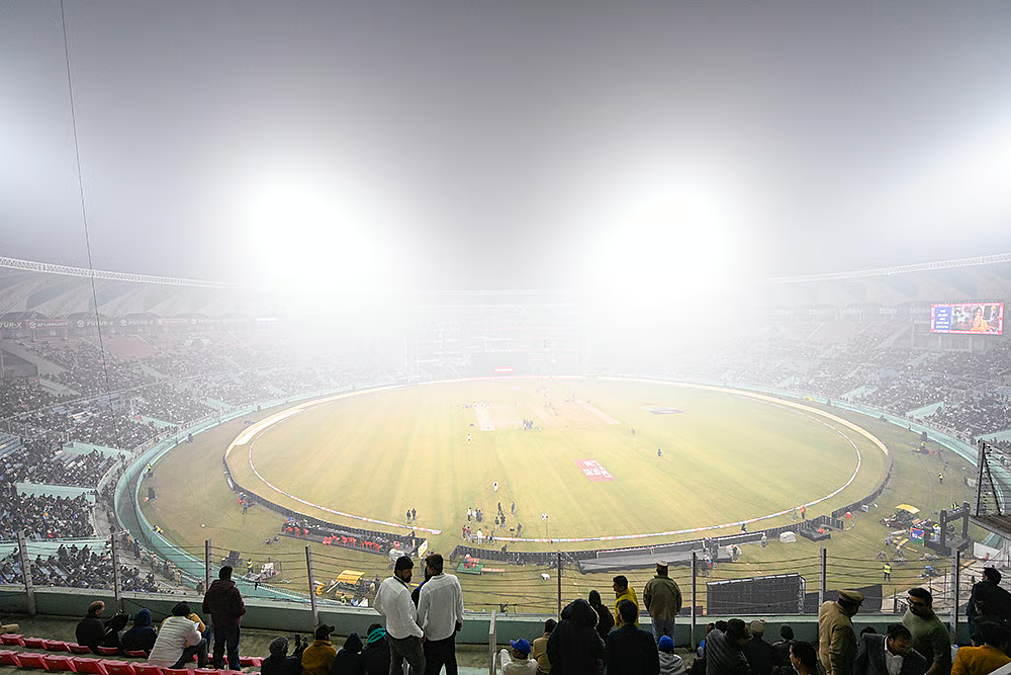
The fact that officials decided to cancel rather than proceed signified the exceptional severity of the Lucknow situation and the genuine commitment to player safety that overrode other considerations like tournament scheduling or fan expectations.
The BCCI Under Fire: Scheduling in Winter
The cancellation of the match opened floodgates of criticism directed squarely at the Board of Control for Cricket in India (BCCI) and their scheduling practices. The core issue revolves around a seemingly obvious but overlooked reality: December is peak fog season in northern India, yet the BCCI had scheduled multiple matches in this region during this exact period.
Why Was This A Problem?
The India versus South Africa series venues included cities such as New Chandigarh, Dharamsala, Lucknow, Ranchi, Raipur, Visakhapatnam, Cuttack, Ahmedabad, Guwahati, and Kolkata, with matches spread across November and December. Of these venues, several—particularly those in northern India—experience their worst air quality and foggiest conditions precisely during mid-December to mid-January.
What made the Lucknow selection particularly questionable was that it marked the first time the venue was hosting a night T20I in December. In its previous hosting history (2019 to 2023), the stadium had only hosted T20 fixtures during November, January, or February—months that generally offer better visibility conditions than mid-December.
The BCCI’s Response
Following the cancellation, BCCI Vice-President Rajiv Shukla broke the organization’s initial silence on the matter. While acknowledging the disappointment, Shukla noted that all preparations had been completed and inspections had continued until the last possible moment. More significantly, he admitted that the period from December 15 to January 15 poses consistent challenges in northern India and pledged that future scheduling would factor in these weather realities.


“Fog is a very big problem from December 15 to January 15. So I feel that while rescheduling in the future, this aspect will also have to be kept in mind,” Shukla stated, effectively conceding that the BCCI had made an error in judgment with this series’ scheduling.
A Lesson in Weather Planning
The backlash against the BCCI points to a broader principle in sports event management: while nature cannot be controlled, its patterns can be anticipated. India’s diverse geography provides the BCCI with considerable flexibility in venue selection, yet the organization had not leveraged this advantage sufficiently when planning this crucial bilateral series.
The Broader Climate and Pollution Crisis in Northern India
The cancellation of the match also brought into sharp focus the environmental and health crisis that northern India faces during the winter months. The fog that enveloped Lucknow on December 17 was not an anomaly but rather a symptom of a systemic problem affecting millions of Indians annually.
Winter Fog in Northern India
Lucknow, like many cities in the Indo-Gangetic plain, experiences dense fog during the winter months due to a combination of meteorological factors. Sharp temperature drops, combined with stagnant atmospheric conditions and high moisture content, create ideal circumstances for fog formation. A local source told India Today that Lucknow had experienced particularly sharp temperature drops in recent days, intensifying the fog cover.
During the cricket match on December 17, the fog alert in Lucknow remained at ‘yellow’ alert status, with visibility reduced to 50-200 metres. These conditions, while manageable for everyday activities, become genuinely dangerous when applied to a sport like cricket, where quick reactions and precise tracking of a fast-moving object are essential.
Air Quality and Public Health Implications
The hazardous AQI levels recorded during the match cancellation (above 400) reflect a larger environmental crisis that extends far beyond the cricket pitch. The Indo-Gangetic plain, spanning northern India from Punjab to Bengal, regularly experiences some of the worst air quality in the world duringthe winter months.
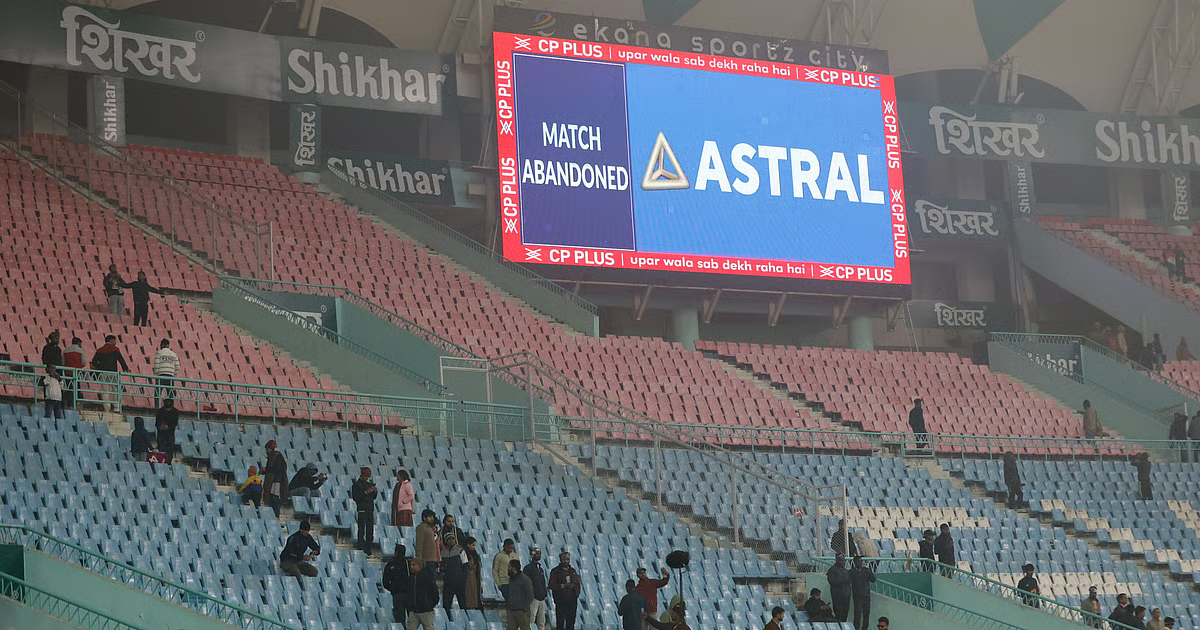
The presence of visible masks on players like Hardik Pandya was a stark reminder that these are not just statistical measurements in air quality reports, but lived experiences affecting human health and athletic performance. The decision to abandon the match essentially acknowledged that even elite athletes with access to world-class medical support could not safely perform in these conditions.
Impact on the Series and Future Matches
With India leading 2-1 in the five-match T20I series, the abandonment of the fourth T20I meant that the series decider would be played in Ahmedabad on Friday, December 19, 2025. The final match would determine the overall winner of the T20I series, making it a high-stakes encounter.
The series result was particularly significant given that both teams were preparing for the T20 World Cup scheduled for February-March 2026. India’s unbeaten streak of 13 T20 series wins gave them considerable momentum, while South Africa would be looking to salvage something from what had been a disappointing tour so far, having lost both the Test series (0-2) and ODI series (1-2).
BCCI’s Commitments and Ticket Refunds
The match cancellation raised practical questions about spectator compensation and ticket refunds. The BCCI ultimately addressed these concerns by confirming that refunds would be provided to fans who had purchased tickets for the Lucknow fixture, acknowledging the disappointment and inconvenience caused to cricket enthusiasts.
Additionally, the board committed to reviewing its scheduling practices for future series, with the explicit goal of avoiding similar situations where matches are scheduled in regions experiencing predictable weather challenges.
Why This Match Matters to Indian Cricket
The cancellation of the Lucknow T20I represents more than just a postponed sporting event. It encapsulates several important themes in modern Indian cricket:
Player Welfare as a Priority: The decision to cancel rather than proceed demonstrated that player safety had become paramount, even when commercial and scheduling pressures might suggest otherwise.
Environmental Accountability: The incident brought environmental concerns to the forefront of the cricket discourse, highlighting the real-world consequences of pollution and climate-related challenges in India.
Scheduling and Governance: The event exposed gaps in the BCCI’s planning processes and raised questions about how major sports organizations should account for seasonal variations in venue suitability.
Tournament Integrity: While disappointing for all stakeholders, the cancellation preserved the integrity of the competition by ensuring that the final match would be played under safe and fair conditions.
Looking Ahead: Lessons and Future Implications
The Lucknow fog incident serves as a watershed moment for the BCCI and potentially for international cricket more broadly. Several key takeaways emerge from this event:
Climate-Aware Scheduling: The board has acknowledged the need to factor seasonal weather patterns into match scheduling. This likely means reducing the number of matches in northern India during December-January and redistributing fixtures to regions with more stable weather conditions during this period.
Enhanced Weather Monitoring: Moving forward, match organizers may invest more heavily in real-time air quality and weather monitoring systems, allowing for more informed decisions about whether matches can proceed.
Infrastructure Improvements: There may also be a push to explore technological solutions that could mitigate some of the visibility challenges posed by fog, though such solutions are unlikely to address the health and safety concerns posed by hazardous air quality.
International Coordination: As cricket becomes increasingly affected by environmental factors, there may be discussions at the level of international cricket boards about establishing more consistent safety standards regarding air quality and visibility conditions.
Conclusion
The cancellation of the India versus South Africa 4th T20I at Lucknow’s Ekana Stadium on December 17, 2025, will be remembered as a turning point in Indian cricket—not for what happened on the field, but for what prevented anything from happening at all. Dense fog reducing visibility to dangerous levels and hazardous air quality with AQI readings above 400 made it impossible for players to compete safely, forcing match officials to take the unprecedented step of abandoning a major international cricket fixture.
While the immediate impact was the disappointing cancellation of a match that millions of cricket fans had anticipated, the broader implications extend to governance, player welfare, environmental accountability, and scheduling practices within Indian cricket. The BCCI’s acknowledgment that December 15 to January 15 represents a challenging period for northern India venues suggests that future series will be planned with greater attention to seasonal variations.
As international cricket continues to grapple with environmental challenges exacerbated by climate change and pollution, the Lucknow fog incident stands as a reminder that even the world’s most prestigious sporting events are not immune to the real-world consequences of our changing environment. The fifth T20I in Ahmedabad would now determine the series winner, playing out against the backdrop of this unprecedented cancellation.





Leave a ReplyCancel reply