


The Duel at the Summit: Kohli’s Spectacular Rise to No. 2
The ICC Men’s ODI Batting Rankings have been dramatically reshaped, reigniting one of the most compelling individual rivalries in cricket. Following a sensational performance against South Africa, Virat Kohli has catapulted two places to seize the coveted No. 2 position, putting him directly on the heels of his teammate and current world No. 1, Rohit Sharma. This is not merely a ranking change; it signifies Kohli’s full return to his most authoritative form in the 50-over format, marking his closest push toward the top spot since he was last displaced in April 2021.
The latest update, released by the International Cricket Council (ICC) on December 10, 2025, confirms the Indian dominance at the top of the white-ball game. While Rohit Sharma retains his premier position, the margin has been whittled down to a tantalizingly small gap of just eight rating points. This incredibly tight race for the world’s best ODI batter crown sets up an electric subplot for India’s upcoming white-ball assignments, turning every innings played by these two giants into a crucial, rank-defining moment.

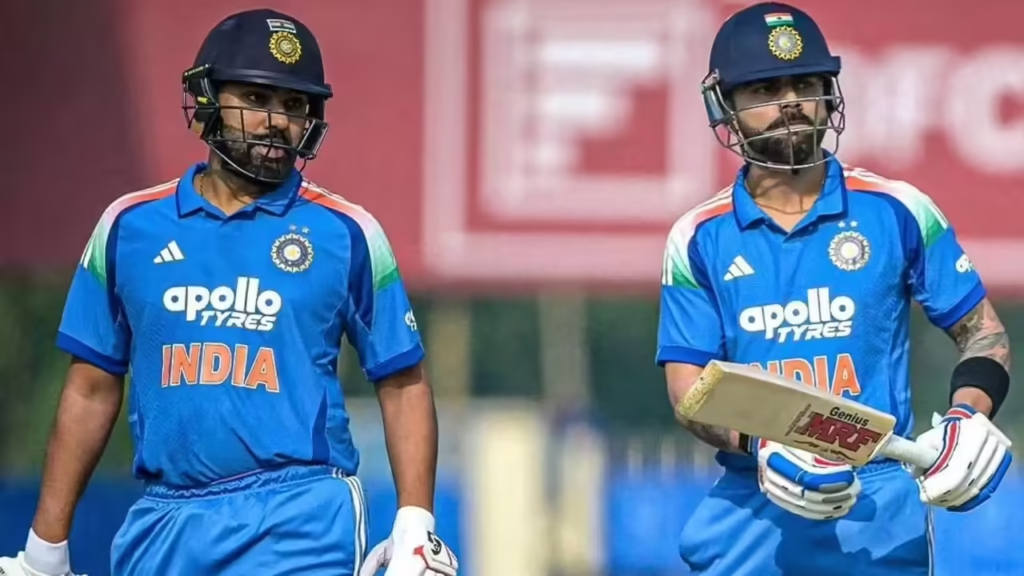
The narrative of Kohli closing in on Rohit is more than just statistics; it’s a testament to the enduring excellence of two of modern cricket’s legends, both of whom have focused their late-career energies almost entirely on the ODI format. Their combined presence at the top of the global charts underscores India’s unchallenged status as a powerhouse in One Day International cricket, a dominance further highlighted by the presence of a third Indian star, Shubman Gill, in the top five.
The Numbers Game: Analysing the ICC ODI Batting Rankings
To truly appreciate the razor-thin margin separating the two Indian icons, we must delve into the latest ICC figures. The ranking system is fluid, constantly adjusting based on the quality, impact, and recency of a player’s performance.
ICC Men’s ODI Batting Rankings (Top 10 – Dec 10, 2025)
The current standings reflect the impact of the recent India vs. South Africa and Australia vs. New Zealand series.
| Position | Player | Team | Rating Points | Difference from No. 1 |
| 1 | Rohit Sharma | India | 781 | – |
| 2 | Virat Kohli | India | 773 | 8 points |
| 3 | Daryl Mitchell | New Zealand | 766 | 15 points |
| 4 | Ibrahim Zadran | Afghanistan | 764 | 17 points |
| 5 | Shubman Gill | India | 723 | 58 points |
| 6 | Babar Azam | Pakistan | 722 | 59 points |
| 7 | Harry Tector | Ireland | 708 | 73 points |
| 8 | Shai Hope | West Indies | 701 | 80 points |
| 9 | Charith Asalanka | Sri Lanka | 690 | 91 points |
| 10 | Shreyas Iyer | India | 679 | 102 points |

Table data compiled from the official ICC rankings release dated December 10, 2025.
The Eight-Point Margin: What It Means
A difference of just eight rating points is negligible in the ICC’s complex ranking calculation. Essentially, one substantial, high-impact innings from Kohli—such as a match-winning century against a top-tier bowling attack—could be enough to overturn the deficit and propel him back into the coveted No. 1 spot.
Conversely, a rare failure by Rohit Sharma in the next outing, particularly if combined with a strong score from Kohli, would instantly see the rankings flip. This creates a fascinating and intense rivalry, where the players are competing against each other and themselves to maintain peak performance levels. The last time this duo shared the top two spots so closely was during the golden age of their peak form, and the return to this status signifies their sustained dominance even in the twilight of their celebrated careers.
The Series That Changed Everything: Kohli’s Dominance vs. South Africa
Virat Kohli’s monumental leap to No. 2 is entirely attributable to his spectacular, Player of the Series-winning effort in the recently concluded three-match ODI series against South Africa, which India won 2-1.


The Century Streak: Ranchi and Raipur
The defining feature of Kohli’s resurgence was his phenomenal consistency and ability to convert starts into match-winning scores. His three innings read:
- 135 off 120 balls in Ranchi (A match-winning chase).
- 102 off 93 balls in Raipur (Another crucial century in a high-pressure fixture).
- 65* off 45 balls in Visakhapatnam (A quick-fire, unbeaten knock to seal the series).
The two back-to-back centuries, coupled with the unbeaten 65 in the series finale, gave him a total of 302 runs in the series at a breathtaking average of 151.00 and a strike rate of over 117. The ICC ranking system heavily rewards centuries, especially those scored under pressure and in a winning cause. Kohli‘s masterclass ticked every box, triggering an exponential increase in his rating points and vaulting him past Daryl Mitchell and Ibrahim Zadran. The sheer impact of these scores is why his rating point tally grew by an estimated 22 points in just one rankings update, showcasing the direct correlation between high-impact performances and ranking elevation.
Player of the Series: The Ultimate Impact
Being named the Player of the Series provides the ultimate validation of a batter’s influence. Kohli’s performance not only secured the series for India but also provided the dominant talking point. The longevity of his career, coupled with his current peak form, cements his legacy as perhaps the greatest ODI batter of the generation. This series was a critical component of India’s overall strategy in the lead-up to the 2027 World Cup cycle, providing essential confidence in their batting core.
Rohit Sharma: The Resilient No. 1 and His Recent Form
While the spotlight is currently on Kohli‘s incredible leap, it is crucial to acknowledge the consistent excellence that allows Rohit Sharma to retain his position at the summit. Rohit is a powerhouse of consistency in the format, famed for his ability to score massive centuries and anchor the innings.
Rohit’s hold on the No. 1 spot is built on two key recent series:


- The Australia ODI Series: Rohit’s Player of the Series performance against Australia Down Under was instrumental in his first displacing Daryl Mitchell and climbing to the No. 1 spot. His knack for scoring big, including a match-winning, unbeaten 121 in Sydney, provided the foundation for his 781 points.
- The South Africa Series: While Kohli overshadowed him, Rohit still contributed a respectable 146 runs across the series, which was crucial in defending his rating points against decay and preventing a freefall.
The unique aspect of their current battle is that both players are still producing high-quality performances, meaning the movement in the rankings is due to the differential impact of their scores. Rohit Sharma’s position is a testament to his career-defining consistency, especially in the opening slot, making him one of the most reliable anchors in the world. For a deeper analysis of the strategic impact of Rohit’s opening partnerships, you can review our article on the Evolution of India’s ODI Opening Pair Since 2011.
The Ranking Mechanics: How Does Kohli Get to No. 1?
With the margin at just 8 points, the next series will be a confrontation for the top spot. Understanding the ranking mechanics reveals what Kohli needs to do to complete the climb.
The Weight of Impact: Scoring vs. Winning
The ICC ranking system isn’t simply about volume of runs. It weights performances based on several critical factors:
- Runs Scored: The foundation, but must be paired with other elements.
- Opposition Quality: Runs against the top-ranked teams (like South Africa or Australia) are worth more points than runs against lower-ranked teams.
- Match Situation: Performances in difficult conditions, pressure chases, or series deciders significantly boost a player’s rating. Kohli’s historical strength in chases works heavily in his favor here.
- Strike Rate: Efficiency matters. High-impact scores with a good strike rate (like Kohli’s 65* off 45 balls) are rewarded.
- Match Result: Performances in a winning cause are valued higher than those in a defeat.
To overtake Rohit, Kohli doesn’t necessarily need another 300-run series, but a single, dominant, high-impact century in a winning cause in the upcoming fixtures could be enough to bridge the 8-point gap.
The Upcoming ODI Schedule: India vs. New Zealand
The next and most immediate battleground for the No. 1 ranking is the three-match home ODI series against New Zealand, scheduled to begin in January 2026. This series offers a direct opportunity for both players to gain or lose points.
- If Kohli dominates: If Kohli scores, for example, a century and two fifties, while Rohit has a modest series (say, three scores under 40), the ranking will almost certainly flip.
- If Rohit defends: If Rohit Sharma hits a big century and Kohli has a mixed series, Rohit could extend his lead, creating a larger buffer against the chasing pack.
The fact that both players are playing in the same series means they are essentially competing on the same terms—same pitch, same conditions, same opponent—making the battle intensely personal and compelling for fans worldwide.

The Unprecedented Indian Domination: Three in the Top Five
The current ICC rankings highlight a truly remarkable period of Indian dominance in One-Day International batting. With Rohit Sharma at No. 1, Virat Kohli at No. 2, and the young sensation Shubman Gill at No. 5, India boasts an unprecedented concentration of top-ranked batting talent.
This is a powerful reflection of the strength and depth of the Indian ODI setup, showcasing:
- Experience at the Top: The presence of the two senior statesmen, Kohli and Rohit, provides the ultimate benchmark of excellence.
- Youthful Brilliance: Shubman Gill, who had previously held the No. 1 spot, sits comfortably in the top five despite missing the South Africa series, proving he is the future of the format.
- Middle-Order Strength: The inclusion of Shreyas Iyer at No. 10 and KL Rahul (now at No. 12) solidifies India’s claim to having the most formidable and well-rounded batting lineup in world cricket.
This collective strength is a key indicator of India’s chances in the upcoming 2027 ODI World Cup cycle, providing a deep pool of match-winners across all batting positions.
A Look Back: Kohli’s Reign and Rohit’s Late Surge
The current scenario is a throwback to Kohli’s historic dominance and a tribute to Rohit’s late-career resurgence.
- Kohli’s Historical Peak: Virat Kohli last held the No. 1 ODI batting ranking in March 2021. Before that, he enjoyed one of the longest and most consistent reigns in the history of the format, consistently setting new benchmarks for run-scoring and chasing. His career-best rating of 909 points (achieved in 2018) is one of the highest ever recorded.
- Rohit’s Climactic Ascent: While Rohit has always been highly ranked, his climb to the No. 1 position is a relatively recent phenomenon, fueled by his prolific run of form over the last 18 months. He reached the top spot for the first time in his career recently, a remarkable achievement that underscores his consistency as an opener even in his late 30s.
The current contest is essentially a battle between an all-time great reclaiming his throne and a modern-day legend achieving a career-defining pinnacle.
Conclusion
The narrative of Kohli closing in on Rohit at the top of the ODI batting rankings is a gift to cricket fans. With a mere eight points separating the two titans, the upcoming three-match series against New Zealand in January 2026 transforms from a routine bilateral assignment into a high-stakes, direct contest for individual supremacy.
Virat Kohli’s incredible form against South Africa, marked by 302 runs and two centuries, shows the former King is not merely content with being one of the best—he wants to be the best once again. The stage is set for a historic rivalry to reach its crescendo.
Who do you think will emerge as the World No. 1 ODI batter after the New Zealand series: Rohit Sharma or Virat Kohli? Share your predictions, rating point estimates, and reasons in the comments below!





Leave a ReplyCancel reply