


Mahindra XEV 9S is poised to make a bold leap in India’s EV arena with its upcoming Mahindra XEV 9S, set for its global debut on 27 November 2025 during the company’s “Scream Electric” anniversary event in Bengaluru.

What sets the XEV 9S apart is its positioning: this is Mahindra’s first purpose-built, three-row (7-seater) electric SUV, built on Mahindra’s dedicated INGLO skateboard architecture, rather than being a conversion of an internal combustion engine (ICE) vehicle.
This model is more than just a new EV — it’s a statement. With limited direct competition in the mainstream 7-seater EV space in India, Mahindra aims to capture a family SUV segment that has largely remained untapped.
In this deep-dive article, we’ll explore everything we know so far — design, platform, battery, interior, features, pricing, challenges, and why the XEV 9S could reshape Mahindra’s EV roadmap. Serving as India’s first genuine 7-seater electric SUV, the Mahindra XEV 9S is meticulously engineered to eliminate the compromise between electric mobility and family-sized space. Based on official teasers, industry leaks, and analysis of its shared architecture, we present the most exhaustive and humanistic breakdown of the specs, features, positioning, and expected impact of this electric titan.
Platform & Architecture: The INGLO Skateboard Advantage Mahindra XEV 9S
What is the INGLO Platform?
The XEV 9S is built on Mahindra’s INGLO skateboard platform, a modular EV architecture that supports multiple vehicle types and seating layouts.

This platform offers several advantages:
- Flat floor design: Because the battery pack is integrated into the “skateboard,” the cabin has a flat floor, which improves interior space and flexibility, especially for the third row.
- Structural rigidity + safety: Skateboard architectures typically allow for better crash structure and battery protection.
- Future scalability: The same platform underpins other Mahindra EVs, including the XEV 9e and BE 6, allowing Mahindra to reuse key components and optimize development costs.
Strategic Importance
By using INGLO for the 9S, Mahindra leverages its existing EV tech stack — especially the battery options — while pushing into a more ambitious vehicle category: a full three-row SUV. This reflects Mahindra’s evolving EV ambition.
Design & Exterior: Blending Family Utility with Electric Style Mahindra XEV 9S
Silhouette & Body Shape
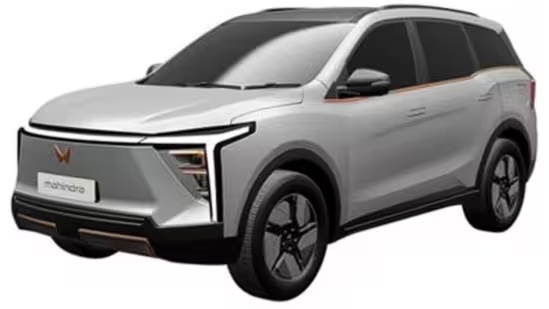
The XEV 9S teases a more upright and practical profile compared to the sportier rooflines of Mahindra’s other born-electric EVs (like the BE 6 or the XEV 9e).
- It is believed to be over 4,700 mm long, making it a substantial SUV in size.
- The design retains a visual kinship with the XUV700 (an ICE SUV), but reinterprets it in EV form.
Front & Rear Styling Highlights
- The front grille is fully closed off, a hallmark of EV design, with Mahindra’s electric badging.
- A sleek, full-width LED light bar and Y-shaped daytime running lights (DRLs) add a modern, aggressive look.
- The headlight units are vertically stacked, dual-pod design, similar to those on the XEV 9e.
- On the rear: connected LED taillights, reworked bumper with skid-plate styling, and subtle sporty touches.
- Aero‑optimized alloy wheels and flush-fitting door handles further enhance the EV aesthetic.
Color, Accents & Branding
- Expect subtle blue EV accents around badging, lighting, or side cladding to emphasize electric identity.
- Glossy black cladding around wheel arches and lower body panels lends a premium feel.
Interior & Cabin Features: Tech‑Heavy, Flexible & Family Oriented Mahindra XEV 9S
Layout & Seating Configuration
- 7-seater layout: Likely in a 2 3–2 configuration (two seats in the front, three in the second row, two in the third).
- The middle row is reported to be sliding, thanks to the flat floor, allowing more legroom or easier access to the third row.
- The third-row seats are expected to fold, offering flexibility between cargo and passengers.
Dashboard & Displays
- Triple-screen setup:
- A driver display (instrument cluster)
- A central infotainment touchscreen
- A co-passenger screen on the dashboard for customizing content or interacting with media.
- Two-spoke steering wheel with an illuminated Mahindra logo and haptic controls for modern functionality.
- Piano black accents and glossy finishes on the center console and gear lever areas.
Comfort & Luxury Features
- Ventilated and powered front seats, likely with memory function (as per teaser reports).
- Multi-zone climate control: Reports suggest dual- or even 3-zone climate control to keep all rows comfortable.
- Panoramic sunroof: While some Mahindra EVs have fixed-glass roofs, the 9S is expected to get an openable panoramic sunroof, enhancing the sense of space and light.
- Ambient lighting: Multi-color ambient lighting to set moods in the cabin.
- Wireless charging pads, likely multiple, given the three-row layout.
- Harman Kardon audio: A premium sound system is expected, similar to other high-end Mahindra EVs.
- Head-up display (HUD) for projecting key driving information.
Connectivity & Smart Features
- Connected car tech: Likely supports remote functions, over-the-air updates, navigation, and more.
- Remote parking assist: The 9S is expected to offer remote parking capabilities.
- “Groove Me” mode: As reported, a function that synchronizes ambient lighting and music to create an immersive experience.
- 7-airbag safety: Reports suggest a strong safety package.
Powertrain, Battery & Range: How Far Can the XEV 9S Go?
Battery Options
Based on current reporting and platform sharing:
- The XEV 9S is expected to use two battery options: 59 kWh and 79 kWh, likely LFP chemistry — similar to the XEV 9e and BE 6.
- These battery sizes give flexibility across variants: from more affordable, lower-range models to long-range premium versions.
Motor & Drivetrain
- Rear-wheel drive (RWD) is likely for both battery options, as per early spec leaks.
- Power estimates:
- 59 kWh variant: around 231 PS, ~380 Nm torque
- 79 kWh variant: around 286 PS, same torque (380 Nm)
- There is speculation about a potential AWD (all-wheel drive) version: According to Autocar, Mahindra may add a second motor to the front axle in some variants.
Driving Range & Charging
- Claimed range:
- ~ 542 km for the 59 kWh version
- ~ 656 km for the 79 kWh version
- Charging:
- DC fast charging: Up to 175 kW reported (20–80% in ~20 minutes) — based on platform siblings.
- AC charging: Likely 11 kW onboard charger, suitable for home charging.
Performance Estimates
- 0–100 km/h for the 59 kWh might be around 7.5 seconds, and for the 79 kWh, possibly 6.8 seconds, based on extrapolation from platform siblings.
- These are estimates; Mahindra has not officially confirmed acceleration figures.
| Specification | Standard Variant (Expected) | Long Range Variant (Expected) |
| Battery Capacity | 59 kWh (LFP) | 79 kWh (LFP) |
| Drivetrain | Rear-Wheel Drive (RWD) | Rear-Wheel Drive (RWD) |
| Max Power Output | 231 PS (approx. 170 kW) | 286 PS (approx. 210 kW) |
| Peak Torque | 380 Nm | 380 Nm |
| Claimed Range (Based on XEV 9e) | 542 km (Certified) | 656 km (Certified) |
| Real-World Range (Estimated) | 350 – 400 km | 450 – 550 km |
| AWD Option | Speculated (Dual-Motor setup for top-end) | Speculated (Dual-Motor setup for top-end) |
Safety & Driver Assistance
Level 2 ADAS: The XEV 9S is expected to support Level 2 driver assistance, likely including functions such as adaptive cruise control, lane-keeping, and automated braking.

360° camera: A surround-view camera system is reportedly part of the safety suite.
Electronic Stability Control (ESC), ABS with EBD, TPMS (tire-pressure monitoring), and multiple airbags (reportedly up to 7) are expected.
Hill-hold assist and possibly other driving aids may also be offered for enhanced usability.

Pricing & Market Positioning
Expected Price Range
- According to most media reports, the XEV 9S is likely to cost between ₹ 22 lakh and ₹ 35 lakh (ex-showroom), depending on battery and variant.
- Some sources, like CarHP, suggest a similar range, albeit with slightly different upper estimates.
Competitive Positioning
- Segment advantage: As a 7-seater SUV, the XEV 9S is expected to compete with very few direct rivals. India Today notes that while the Kia Carens Clavis EV offers seven seats, it has an MPV-style body rather than a true SUV-style, giving Mahindra a differentiation advantage.
- EV ecosystem positioning: Within Mahindra’s own EV lineup, the 9S sits above the XEV 9e, offering more space, premium features, and family usability.
- Strategic bet: The 9S could be a cornerstone of Mahindra’s EV ambitions, helping the company gain market share in premium EVs.
Challenges & Risks
While the XEV 9S shows a lot of promise, there are several headwinds and challenges Mahindra may face:

Price Sensitivity
- The wide expected price range (₹ 22 lakh–₹ 35 lakh) could be a double-edged sword: while the base variant may be competitive, the top trim could be cost‑prohibitive for many buyers.
- For a large EV with premium features, Mahindra needs to convincingly justify the pricing to family buyers.
Charging Infrastructure
- With long-range variants, fast-charging infrastructure becomes critical. If DC fast-charging stations are limited in certain regions, this could impact real-world usability.
- Even though 175 kW DC charging is very capable, customers may be constrained by the availability of these high-power chargers.
Competition (Future Risk)
- While the 9S currently enjoys a relatively underserved segment, EV competition is heating up rapidly. Other automakers could launch their own 7-seater EVs.
- Mahindra will need to maintain a lead in features, technology, and price to defend its position.
Build & Service Risks
- Scaling up a three-row EV may bring production challenges, especially ensuring consistent quality for a large vehicle.
- Post-sales service, battery maintenance, and the cost of repairs will be important. Customer trust will play a big role, especially as EV adoption grows.
Customer Expectations
- With high expectations for luxury, space, and technology, any compromise — whether in real-world range or feature delivery — could disappoint.
- Educating customers on EV costs, charging behavior, and maintenance will be critical.
Why the Mahindra XEV 9S Could Be a Game-Changer
Putting together its strengths, the XEV 9S has the potential to transform Mahindra’s EV strategy and significantly impact the Indian EV SUV market:
- Fills a unique niche: A true 7-seater electric SUV is rare in India’s EV market — the 9S helps Mahindra address a major gap.
- Leveraging existing EV tech: By building on the INGLO platform and sharing battery options with existing models, Mahindra optimizes its R&D and cost structure.
- Family-first design: With sliding second row, foldable third row, and spacious interiors, the 9S is clearly aimed at family buyers — a very large potential market.
- Premium but practical: Luxury features (triple screens, panoramic sunroof, rich infotainment) combined with utility make it aspirational yet usable.
- Strategic EV roadmap anchor: The 9S could be a flagship model in Mahindra’s “Born Electric” lineup, amplifying its EV credibility.
What to Expect on 27 November 2025
Here’s what automotive enthusiasts, potential buyers, and analysts should watch for at Mahindra’s big event:
- Full reveal: Official styling, dimensions, and detailed images (interior + exterior).
- Confirmed specs: Battery capacities, power (PS), torque, and motor configuration.
- Range figures: Real-world and claimed range for variants.
- Trim levels: Variant breakdown, features by model, and price confirmation.
- Performance: Acceleration times (0–100 km/h), top speed, handling.
- Charging capabilities: AC and DC charging specs, onboard charger, and charging partners.
- Safety & ADAS: Detailed preview of driver assistance features and safety equipment.
- Booking / Launch timeline: When bookings open, expected deliveries, and export plans.
- Strategic roadmap: How the 9S fits into Mahindra’s broader EV future — more models, infrastructure partnerships, sustainability goals.
Real-World Use Cases: Who Is the XEV 9S For?
To understand the impact of the XEV 9S, let’s imagine some use‑case scenarios:
The Large Family
A 5- or 6-member Indian family (parents + 3–4 kids) wanting an EV:
- The 9S offers real three-row space.
- Sliding the second row makes the third row more accessible.
- Weekend road trips become more viable with its long-range battery.
- Comfort: Ventilated seats, multi-zone AC, panoramic sunroof for long drives.
Ride-Share / Taxi Business
A fleet or premium ride-share operator:
- 7 seats maximize passenger capacity.
- EV running costs are lower than ICE.
- Fast-charging allows for a quick turnaround.
- Technology (ADAS, connected car) helps with safety and efficiency.
Corporate / Executive Shuttle
A company buying EVs for employee transport or VIP shuttle:
- Premium interior and advanced infotainment make it comfortable for executives.
- Connectivity and remote features can be used for fleet management.
- Safety features (ADAS, 360° camera) can be leveraged for liability reduction.
Weekend Road-Tripper
A young couple with occasional large-group trips:
- The 79 kWh variant (656 km claimed) is useful for highway drives.
- The flat floor and foldable third row give flexibility for luggage.
- Charging infrastructure + fast charging makes long-distance EV travel more feasible.
Media & Buzz: What the Press & Public Are Saying
- Livemint confirms the launch date and underscores the importance of the INGLO architecture.
- India Today dives into expected pricing and the strategic gap Mahindra is addressing.
- Autocar India highlights interior features like the openable sunroof and triple-screen layout.
- EV Drive offers detailed speculation on design, powertrain, and range.
- On Reddit, early enthusiasts are excited: “Mahindra XEV 9S … debuts Nov 27 with 500km range, Dolby Atmos sound, and luxurious tech-packed interiors.”
“Boss mode & reclining rear seats confirmed.”
Environmental & Social Impact
By introducing a large EV SUV, Mahindra encourages family EV adoption, potentially reducing overall CO₂ emissions in multi-passenger use.
The INGLO platform’s modular nature could encourage more EVs from Mahindra, promoting mass electrification.
If priced competitively, the 9S may stimulate EV adoption in semi-premium segments, pushing rivals to accelerate their EV plans.
The 9S may promote shared mobility solutions (ride-pooling, EV taxis), given its seven-seat layout.
Conclusion
The Mahindra XEV 9S is shaping up to be a defining moment for Mahindra’s EV ambitions: a large, three-row, fully electric SUV that doesn’t compromise on space, luxury, or technology. With its launch scheduled for 27 November 2025, the 9S is not just another EV — it’s a strategic bet on the future of family mobility in India.
If Mahindra nails its pricing, delivers on real-world range, and leverages its INGLO platform efficiently, the XEV 9S could become a cornerstone of India’s EV future — from growing its own EV ecosystem to encouraging wider adoption among families and fleet operators alike.
However, success is not guaranteed. Execution will matter: from production quality to charging infrastructure, from after-sales to consumer education. The 9S represents a leap, but the leap must be well-managed.



Leave a Comment