


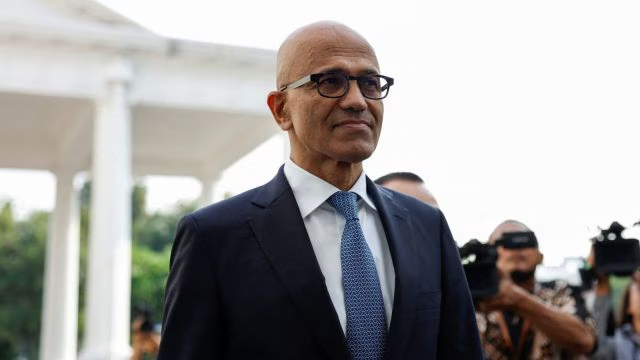
Microsoft CEO Satya Nadella reveals that Microsoft has “all” system-level IP from OpenAI’s custom AI accelerator designs (except for consumer hardware), enabling it to deliberately evolve its Maia chips while still leveraging NVIDIA GPUs. AI-Chip

AI-Chip Background & Context
In a recent interview, Microsoft CEO Satya Nadella dropped a bombshell: Microsoft has full access to OpenAI’s system-level intellectual property (IP) related to AI chip design — barring only consumer hardware. This revelation underscores just how tightly integrated Microsoft and OpenAI have become, not just at the software model level, but all the way down to the silicon level.
To appreciate the significance of this, it helps to understand the backdrop:
- OpenAI’s chip strategy is expanding. In October 2025, OpenAI announced a multi-year collaboration with Broadcom to co-develop custom AI accelerators. The plan involves deploying 10 gigawatts of OpenAI-designed chips + networking systems across data centers by 2029.
- Broader compute partnerships. Beyond Broadcom, OpenAI has also secured large-scale compute commitments from NVIDIA (via a massive investment) and AMD.
- Energy constraints loom. Nadella has previously warned that in the AI race, compute is no longer the bottleneck — power is.
- Microsoft’s own Maia chip roadmap is under pressure. According to reports, the mass production of Microsoft’s AI chips (originally code-named “Braga” / to become Maia) has been delayed to 2026 due to design revisions, staffing changes, and high turnover.
These factors combine to create a high-stakes environment. Microsoft is not merely a cloud provider for OpenAI’s models — through this IP access, it’s becoming a deeply embedded hardware collaborator, giving it a strategic edge in the AI infrastructure arms race.
What Nadella Actually Said: Key Takeaways AI-Chip
Here are the main points from Nadella’s comments, based on his interview and subsequent media coverage:

- Full access to OpenAI’s accelerator IP (except consumer hardware):
Nadella confirmed that Microsoft gets all system-level IP from OpenAI’s AI accelerator work, with the only carve-out being consumer hardware. - A reciprocal technology flow:
Microsoft didn’t just passively receive IP. According to Nadella, Microsoft itself contributed IP in the form of supercomputing infrastructure and early designs: “We built it for them … we built supercomputers together … now as they innovate … we get access to all of it.” - Strategic pace for Maia development:
Nadella said this IP pipeline allows Microsoft to evolve its Maia AI chips deliberately, without being forced into a reckless “custom chip arms race”: “If you build your own vertical thing, you’d better have your own model … and you have to generate your own demand for it or subsidize the demand for it.” In other words, Microsoft wants its silicon roadmap to closely align with its internal AI model demand — not just build chips for the sake of owning silicon. - NVIDIA remains central, but TCO matters:
Despite its in-house ambitions, Microsoft still heavily relies on NVIDIA GPUs. Nadella emphasized that any internal accelerator must be cost-competitive: “In a fleet, what I’m going to look at is the overall TCO (total cost of ownership).” He noted that even large cloud rivals (like Google and Amazon) continue to buy NVIDIA — “because NVIDIA is innovating, it’s general-purpose, all models run on it, and customer demand is there.” - Closed-loop between Maia models and silicon roadmap:
Microsoft plans to maintain a tight feedback loop between its internal AI (“MAI”) models and the microarchitectures it builds:- Its internal models will inform what the silicon should do.
- New designs (including OpenAI’s) will be deployed first, then extended into Microsoft’s own infrastructure once validated.
- Nadella said Microsoft will use OpenAI-built systems first, and then expand or “industrialize” them across its cloud.
Why This Matters — Strategic Implications
Here’s what Nadella’s claims mean for Microsoft, OpenAI, and the broader AI ecosystem — and why this could shift the strategic balance in the AI infrastructure race.
A. Microsoft’s Competitive Edge Grows
- Layered advantage: Having system-level IP from OpenAI gives Microsoft more than just access to models — it gives it design know-how. This lets Microsoft optimize its own infrastructure (its “Fairwater” data centers, for example) for future AI workloads.
- Reduced vendor risk: While Microsoft remains tied to NVIDIA GPUs, the IP gives it optionality: it can build internal silicon when it makes sense, without being fully dependent on external chip vendors.
- Aligned incentives: Because Microsoft helped build OpenAI’s earlier infrastructure, there is a deeply aligned technology loop. This isn’t just a customer-partner relationship; it’s co-evolution.
B. OpenAI’s Infrastructure Ambitions Strengthen
- Broadcom partnership: OpenAI’s deal with Broadcom to deploy 10 GW of custom AI accelerators is a huge bet.
- Self-optimized compute: OpenAI claims to embed learnings from its AI models directly into silicon — potentially increasing efficiency, performance, and cost-effectiveness.
- Layered scaling: With Broadcom building flip racks (accelerators + networking), OpenAI builds hardware tailored to its model needs, instead of relying purely on third parties.
C. The AI Infrastructure Arms Race Intensifies
- Google, Amazon, and other cloud players: Nadella’s remarks hint that Microsoft is not just following others — it’s shaping its silicon roadmap on its own terms. Meanwhile, other hyperscalers are also building custom chips, but Microsoft’s direct IP tie-ups with OpenAI give it a differentiated edge.
- Energy constraints: With Microsoft and others citing power as a key bottleneck, the race may not just be about compute, but power efficiency. Novel custom accelerators (or optimized GPUs) might become more critical than raw performance.
- Capital intensity: Building custom silicon and data centers is capital-intensive. With the promise of 10 GW from Broadcom and large-scale cloud build-outs (e.g., Microsoft’s Fairwater), the infrastructure demands are skyrocketing.
Risks and Challenges
While the strategy is bold and offers potential long-term rewards, there are some real risks Microsoft and OpenAI will need to navigate:
- Delayed chip production: Microsoft’s Maia (aka “Braga”) chips have reportedly been delayed to 2026. If timelines slip further, Microsoft risks falling behind in both internal deployment and cost savings.
- Cost-competitiveness vs. NVIDIA: New accelerators must compete not just on performance but on total cost of ownership (TCO). If Microsoft’s in-house design is more expensive to run or maintain, cloud customers may prefer tried-and-tested NVIDIA racks.
- Power & infrastructure constraints: If electricity remains a key bottleneck (as Nadella suggests), scaling massive compute clusters could hit sustainability or cost ceilings.
- Technology risk: Custom chips are complex. Even with IP access, translating designs into mass-deployable hardware is non-trivial. Bugs, yield issues, or manufacturing bottlenecks could derail deployment.
- Strategic alignment with OpenAI: Though the IP exchange is mutually beneficial, Microsoft still depends on OpenAI models to drive demand for its silicon. If OpenAI’s strategy shifts, Microsoft could be exposed.
What’s Next: Microsoft & OpenAI Roadmap
Here’s how Microsoft might move forward, based on Nadella’s vision and public signals:
- Deploy OpenAI-designed accelerators in Microsoft data centers: Use the IP from OpenAI to build or “industrialize” new accelerators in its Fairwater and other AI-optimized data centers.
- Maintain hybrid infrastructure: Even with internal silicon, Microsoft will continue to run large parts of its AI workloads on NVIDIA GPUs — balancing performance, cost, and flexibility.
- Tight model–silicon feedback loop: Microsoft’s MAI models (its internal AI systems) will guide future microarchitecture designs. Simultaneously, performance data from real deployments will feed back into model training and optimization.
- Scale responsibly: Rather than rush into mass deployment, Microsoft may prioritize deliberate growth, ensuring that each generation of Maia or custom hardware delivers meaningful value.
- Leverage IP beyond datacenters: Over time, Microsoft might repurpose some of the OpenAI IP (where licensing permits) for enterprise or edge AI workloads — though the consumer-hardware IP remains outside its scope.
Why This Could Be a Game Changer
Strategic sovereignty: By owning or co-owning the silicon IP, Microsoft gains more control, reducing its reliance on external chip vendors and potentially lowering long-term costs.
AI stack integration: Microsoft’s vision appears to be building a vertically integrated AI stack — from models (OpenAI) → custom silicon → data centers → cloud services. This could accelerate innovation and efficiency.

Long-term Moat: Access to OpenAI’s system-level IP gives Microsoft a potential moat. If Microsoft can effectively translate that IP into deployable, efficient silicon, it could be more resilient in the infrastructure race.
Partnership leverage: The deep IP-level partnership further cements Microsoft-OpenAI ties. That could have strategic implications beyond just computing, including future research, model development, and infrastructure scale.
Feature Image Concept
Concept: A high-resolution illustration or digital artwork showing silicon circuitry merging into a neural network — representing the convergence of hardware (chips) and AI models.
Elements:

- A stylized AI chip (silicon die) in the foreground.
- Neural network lines (nodes + connections) flow out of the chip into cloud-like structures.
- Microsoft and OpenAI logos subtly integrated into the design (optional).
- A slightly futuristic, tech-blue color palette with gradient lighting to evoke innovation.
Conclusion
Satya Nadella’s confirmation that Microsoft holds full access to OpenAI’s system-level AI-chip IP marks a pivotal moment in the evolving landscape of AI infrastructure. This isn’t merely a partnership—it’s the formation of a deeply integrated technological ecosystem where Microsoft gains unprecedented visibility and influence over the hardware that will power the next generation of AI models.
By tapping directly into OpenAI’s accelerator designs, Microsoft strengthens its long-term strategy:
- advancing its Maia silicon at a deliberate, cost-efficient pace,
- maintaining a flexible hybrid infrastructure dominated by high-performing NVIDIA GPUs,
- and ensuring future chips align tightly with the demands of its internal MAI models.
At the same time, OpenAI’s bold moves—like its 10-gigawatt Broadcom accelerator initiative—are reshaping what scalable, AI-native compute looks like. With Microsoft’s reciprocal IP contributions and operational scale, this partnership continues to push the boundaries of what is technically and economically feasible.
Ultimately, Nadella’s comments highlight an industry shifting toward vertical integration, where software, models, silicon, and data centers co-evolve in a closed loop. In this race, the winners won’t just be those with the fastest chips, but those with the smartest, most synergistic ecosystems. And with full access to OpenAI’s AI-chip IP, Microsoft is positioning itself as one of them.
For more info, check out: mizulet



Leave a Comment