


Google Search has always been more than just a tool for finding information—it’s a digital playground where the company quietly plays hide-and-seek with its users through carefully hidden Easter eggs. From making your screen spin with “do a barrel roll” to tilting everything slightly with “askew,” Google’s developers have long understood that a touch of playfulness can transform a mundane search experience into a memorable moment.

But in December 2025, something extraordinary happened. Without any announcement, fanfare, or official blog post, Google slipped one of the internet’s most chaotic and beloved memes directly into its search functionality. Type “67” or “6-7” into Google Search, and your entire screen begins to move and shake as if dancing along with the viral sensation that’s taken over TikTok, Instagram, and every corner of youth internet culture.
This moment represents something fascinating: the collision between traditional corporate technology and the raw, untamed creativity of internet culture. Google, a company that once seemed distant from the trends that dominate social media, has suddenly become a willing participant in what might be 2025’s most inexplicable yet undeniably captivating cultural phenomenon.
The Rise of 6-7: Understanding 2025’s Most Viral Meme
Before we can fully appreciate why Google decided to join the chaos, we need to understand what the 6-7 trend actually is—and more importantly, why no one can quite agree on what it means.

The story begins in December 2024 with a Philadelphia rapper named Skrilla. He released a drill rap track titled “Doot Doot (6 7)” that featured a hypnotic, repetitive hook where he raps: “I know he dyin’ (oh my, oh my God) 6-7, I just bipped right on the highway.” The phrase “6-7” appears as a rhythmic punctuation mark throughout the song, catching the ear without ever truly making logical sense.

At first, the song circulated primarily within hip-hop circles, but something remarkable happened as it began to spread across TikTok and other platforms: it became exponentially more popular precisely because nobody could agree on what it meant. This ambiguity wasn’t a bug in the meme’s design—it was the feature that made it unstoppable.
The origins of “6-7” have been heavily debated. Some linguists and cultural observers have traced it back to “10-67,” a ten-code used by Philadelphia police to notify officers of a death. Others believe it might reference 67th Street in Chicago or Philadelphia, both areas with significant cultural weight in hip-hop history. Some attribute the explosion to NBA player LaMelo Ball, whose height happens to be 6 feet 7 inches—a coincidence that fueled further speculation.
But perhaps the most telling detail comes from Skrilla himself. When asked about the meaning of “6-7,” the rapper simply stated: “I never put an actual meaning on it, and I still would not want to.” This deliberate refusal to define the phrase became part of the meme’s identity.
Why 6-7 Exploded: The Psychology of Intentional Meaninglessness
The viral explosion of 6-7 tells us something profound about how language and culture work in 2025, particularly among Generation Alpha and Gen Z communities. Interest in the term surged dramatically starting in the summer of 2025, with search queries increasing more than six times since June alone.
The term functions on multiple levels simultaneously. First, it operates as an inside joke—those who are “in on it” understand that there’s nothing to understand, which creates an exclusive club of participants. Second, it works as a social signal. When someone says “6-7,” they’re not conveying information so much as declaring membership in a particular cultural moment.

Steve Johnson, the director of lexicography for Dictionary Media Group at IXL Learning, captured this complexity perfectly when he selected 6-7 as Dictionary.com’s Word of the Year for 2025: “It’s part inside joke, part social signal, and part performance. When people say it, they’re not just repeating a meme; they’re shouting a feeling. It’s one of the first Words of the Year that works as an interjection—a burst of energy that spreads and connects people long before anyone agrees on what it actually means.”
This perspective helps explain the phenomenon’s appeal. In an era where communication often feels transactional and meaning-heavy, 6-7 offers the opposite: a way to express emotion and connection without the burden of specific meaning. It’s chaos with consent, nonsense that somehow makes perfect sense to millions of young people simultaneously.
The meme exploded across every major platform. TikTok videos featuring the sound from “Doot Doot (6 7)” accumulated billions of views. Basketball games saw fans chanting “67” when their team scored that exact number of points. By March 2025, a boy named Maverick Trevillian became known as the “67 Kid” after a viral video showed him excitedly yelling the term at a basketball game while performing an enthusiastic hand gesture—palms facing upward, moving slightly up and down as if weighing two invisible objects.
Schools began reporting that students couldn’t stop saying it. Some educators even banned the phrase from classrooms, a move that only seemed to amplify its appeal among the younger generations. The fact that adults found it baffling, that it had no clear meaning, that it seemed to serve no practical purpose—these became the very things that made it irresistible.

Google Joins the Party: The 67 Easter Egg Explained
Against this backdrop of cultural chaos, Google made its move. Sometime in mid-December 2025, the search giant quietly integrated the 67 meme into its Search interface—and it did so with characteristic subtlety. No announcement. No blog post. No notification. Users simply discovered it organically when they typed “67” into the search bar and watched their screens respond in unexpected ways.

The Easter egg works with elegant simplicity. When you search for either “67” or “6-7” on Google Search, the results page animates in a way that mirrors the hand gesture associated with the meme: the screen gently shakes and moves as if the page itself is participating in the dance. The effect is subtle enough that it doesn’t interfere with actual search functionality—you can still see your results, click on links, and use Google normally—but it’s noticeable enough to catch you off guard and create that moment of delighted surprise.
What makes this Easter egg particularly clever is that it works consistently across both desktop and mobile interfaces. Whether you’re searching on your computer or smartphone, the animation triggers the same way, ensuring that the experience remains consistent regardless of device. The animation takes less than ten seconds to complete, but in that brief moment, your pragmatic search engine briefly transforms into something playful and participatory.
Several users reported initially mistaking the effect for a technical glitch. One early discoverer mentioned checking their browser late at night while looking up sports scores,s when suddenly “my screen started moving. For a second, I thought my browser had broken. Then it clicked. Six seven.” This moment of confusion,n followed by recognition, perfectly captures the essence of what Google was aiming for—that unexpected pause where reality briefly bends toward the absurd.
How to Trigger the 67 Easter Egg: A Step-by-Step Guide
The beauty of Google’s Easter egg approach is that they make these discoveries as simple as possible. There are no complicated menus to navigate, no special buttons to click, no secret codes to enter. Just four straightforward steps:
Step 1: Open Your Web Browser
Any modern browser works—Chrome, Firefox, Safari, Edge, or whatever you prefer. The Easter egg works across all major platforms.
Step 2: Navigate to Google Search
Head to www.google.com or simply use your browser’s search bar if it defaults to Google. Make sure you’re actually on Google’s search interface.
Step 3: Type “67” or “6-7” Without Quotes
Enter either version of the number into the search box. You don’t need quotes; in fact, they might prevent the effect from working properly. Just type the numbers naturally.
Step 4: Wait for the Results Page to Load
Once you hit enter and the results page loads, the animation activates automatically. Your screen will begin to shake and move in that characteristic up-and-down motion, mimicking the hand gesture immortalized by the meme.
That’s it. Within ten seconds, the animation completes, and you’re left with your regular Google Search results page. You can scroll through the results, click on links, and use Google entirely normally. The Easter egg doesn’t interfere with functionality—it’s simply a momentary celebration of internet culture embedded in one of the world’s most serious products.
The effect is subtle and brief, which is precisely what makes it work. Google could have created an elaborate, attention-grabbing animation, but instead, they chose restraint. This restraint is actually more effective because it makes the discovery feel personal—as if the company left a small gift just for you, hidden in plain sight, waiting to be found.
Why Google Did This: The Brand Strategy Behind the Meme

This raises an interesting question: why would Google, a corporation with over 180,000 employees and market dominance in search, take the time to build an Easter egg around a meme that means nothing? Why participate in something so deliberately absurd?
The answer lies in understanding modern brand strategy and how companies maintain cultural relevance in an age where authenticity and relatability matter more than traditional marketing. Google’s history with Easter eggs actually reveals a deliberate strategy. From “do a barrel roll” to hidden games and interactive effects, these digital surprises serve multiple purposes simultaneously.
Engagement and User Delight
First and foremost, Easter eggs drive engagement. Fun brings users back. When someone discovers the 67 animation, they don’t just use Google and move on—they mention it to friends, share it on social media, create videos about it, and in doing so, they become informal marketing ambassadors. The viral spread of “how to trigger the Google 67 Easter egg” across TikTok, Instagram, and Twitter demonstrated exactly how effectively this strategy works.
Brand Personality
Easter eggs establish that Google isn’t just a cold algorithm and search index. They communicate that the company has personality, creativity, and a sense of humor. In an era where tech companies face increasing scrutiny over data privacy and monopolistic practices, demonstrating that there are real humans behind Google—humans who care about delighting users—becomes valuable cultural capital.
Cultural Relevance
By acknowledging and participating in the 6-7 trend, Google signals that it’s paying attention to what young people care about. The company demonstrates that it understands internet culture and is willing to engage with it on its own terms, even when that engagement means embracing something that deliberately resists meaning. This keeps Google from feeling like a corporate dinosaur disconnected from the people who actually use its products daily.
Organic Discovery
Google could have announced this Easter egg with a blog post and social media campaign. Instead, they let it spread organically. Users discovered it themselves, shared it with others, and created an explosion of user-generated content around it. This organic approach feels more authentic than traditional marketing and creates the sense that you’ve stumbled upon something special rather than been sold something.
The Broader Context: Google’s Long History of Hidden Surprises
The 67 Easter egg didn’t emerge in a vacuum. It’s part of a tradition that stretches back years within Google Search. Understanding this context helps appreciate why adding a 6-7 Easter egg feels like a natural evolution of the company’s playful approach to search.
“Do a Barrel Roll” remains perhaps the most iconic Google Easter egg. Search for this phrase, and your entire page spins 360 degrees before settling back into place. It’s a perfect example of how Google uses interactive effects to momentarily transform the ordinary search experience into something surprising.

Then there’s “Askew,” which slightly tilts your results page at an angle, creating a subtle but noticeable disorientation. The effect is small enough that you might initially wonder if something’s wrong with your browser, but once you realize it’s intentional, it becomes delightful.
Google has hidden games, interactive experiences, and animations tied to various search terms and cultural moments. These Easter eggs serve as tiny moments of joy embedded in what could otherwise be a purely utilitarian tool. By continuing this tradition with the 67 Easter egg, Google maintains its position as a company that values user experience not just in terms of search quality, but in terms of creating moments of surprise and delight.
The Cultural Significance: What 67 Means for Internet Culture in 2025
The fact that Google chose to integrate the 6-7 meme into its core search functionality says something profound about how internet culture has evolved and where the line between mainstream and alternative culture now exists.
There was a time when corporate participation in internet memes was awkward acringeworthythy. Brands trying to seem “cool” by using dated slang in their marketing campaigns typically produced eye-rolling results. But the landscape has shifted. The internet’s speed and the genuine integration of online culture into daily life mean that cultural moments like 6-7 aren’t separate from mainstream culture anymore—they’re simply culture, period.
What’s particularly interesting about the 6-7 meme is that it represents a shift in how young people approach meaning and expression. Rather than seeking memes that explain something or make a clever joke about something, 6-7 celebrates meaninglessness itself. It’s an expression of emotion—excitement, chaos, connection—without requiring any underlying significance.
This works as a form of resistance, too, though probably not inane intentional way. When something deliberately resists explanation and interpretation, it becomes resistant to corporate cooption and packaging. You can’t really sell 6-7. You can’t turn it into an advertisement. You can’t explain it in a thirty-second commercial. All you can do is participate in it, and that participation requires genuine cultural awareness rather than calculation.
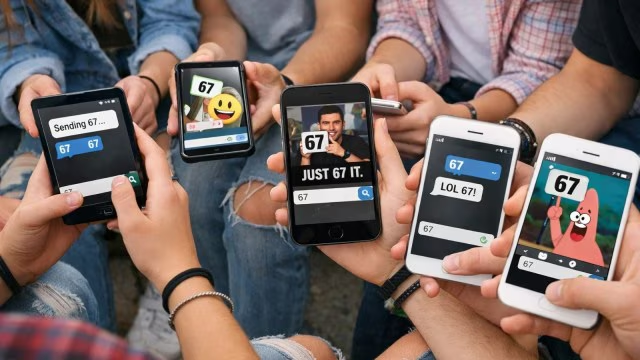
Google’s addition of the 67 Easter egg represents the company recognizing this moment and choosing to participate authentically rather than dismissively. By building the animation rather than explaining or critiquing the meme, Google essentially says: “We see this, we get it, and we want to be part of it too.”
Conclusion
The Google 67 Easter egg represents a fascinating intersection of corporate technology, youth culture, and the strange new rules that govern meaning and virality in 2025. What began as a rhythmic hook in a rap song by Philadelphia artist Skrilla evolved into a global phenomenon that defies explanation, resists corporate cooption, and somehow managed to get Dictionary.com to declare it the Word of the Year.
Google’s decision to build this Easter egg into Search wasn’t just a clever marketing move—it represented recognition that internet culture has fundamentally changed how meaning works. Where previous generations sought memes that explained something or commented on something, this generation created a meme that explicitly resists meaning while somehow meaning everything to those who participate in it.
The brilliance of the 67 Easter egg lies in its simplicity. Type the numbers, watch your screen dance, and for a brief moment, one of the world’s most powerful companies participates in something completely and intentionally absurd. No explanation. No justification. Just the acknowledgment that joy and connection don’t always require meaning.
Try it yourself. Open Google. Type “67.” Let your screen dance. And in that ten-second moment, you’ll be part of something that perfectly captures what it means to be online in 2025: connected to millions of other people, sharing in an experience that makes no sense, and somehow that’s exactly the point.






Leave a Comment