

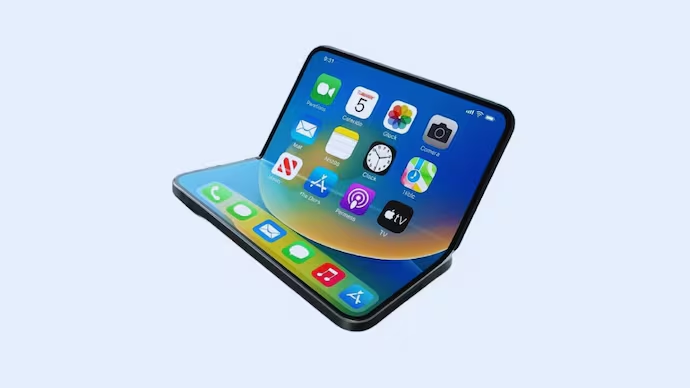
Apple’s first foldable iPhone — widely referred to as the iPhone Fold — has become one of the most talked-about upcoming devices in the smartphone world. For years, rumors have swirled about Apple beating Samsung and other Android rivals to unveil a truly premium foldable, and now, the leaks are converging into a clearer picture: a book-style foldable iPhone launching in late 2026, with a high-end price tag, advanced hinge technology, and a premium build.
In this blog post, we will dive deep into every major leak and analyst claim around the iPhone Fold: its launch timeline, price, design, battery, camera, internal hardware, and other crucial features. We’ll also explore the risks, challenges, and why this device — if real — could reshape Apple’s iPhone strategy.
Background & Why the iPhone Fold Matters
Why Apple Is Entering the Foldable Market
Apple has long watched the foldable smartphone space mature. With rivals like Samsung (Galaxy Z Fold), Google (Pixel Fold), and others pushing foldables, Apple risks being left behind in a potentially transformative category. A foldable iPhone could:
- Revive innovation — The traditional smartphone form factor is becoming saturated; foldable design opens new possibilities.
- Command a premium — Apple can justify steep pricing by targeting early adopters who want something unique.
- Expand its ecosystem — A larger internal display can bridge the gap between iPhone and iPad, enabling new multitasking and app experiences.
- Differentiate — Folding iPhones could become a halo device, reinforcing Apple’s reputation for design and cutting-edge hardware.
These strategic motivations align with what analysts like Ming-Chi Kuo have suggested: Apple is not rushing but is carefully engineering its first foldable to be a flagship-level product.
Launch Timeline: When the iPhone Fold Might Arrive
One of the most consistent themes across leaks and analysis is the 2026 launch window:
- Ming-Chi Kuo, a prominent Apple analyst, has repeatedly claimed that Apple plans to start mass production in Q4 2025, aiming for a late-2026 launch.
- Jeff Pu, another analyst, reportedly said the foldable iPhone has entered the New Product Introduction (NPI) phase at Foxconn, paving the way for production ramp in the second half of 2026.
- JPMorgan analyst Samik Chatterjee has predicted a September 2026 launch, possibly alongside Apple’s iPhone 18 series.
- However, there’s also caution: Mizuho Securities has raised the possibility of a delay into 2027, citing hinge development challenges.
- Reports also suggest that Apple is building up component stock now — possibly for a ramp-up to production.
Summary: The strongest consensus points to late 2026, likely around September, but Apple may still face obstacles that could push the iPhone Fold into early 2027.
The most consistent leak across major analysts like Ming-Chi Kuo and industry insiders is the target date: Fall 2026. This timeframe places the iPhone Fold release directly alongside the flagship iPhone 18 Pro series, cementing its status as a top-tier product.
The Rationale for the 2026 Debut
The two-year lead time from today is crucial and suggests several major technical hurdles have either recently been cleared or are nearing completion in the R&D stage.
- Hinge Durability Certification: Apple’s rigorous quality control demands millions of folds without compromise. The advanced hinge mechanism, reportedly the most expensive single component in the device, requires a lengthy testing and certification process, which likely accounts for much of the delay.
- The 24MP UDC Breakthrough: As detailed later, the rumored high-resolution Under-Display Camera (UDC) on the inner screen is a technical marvel. Mass-producing a high-quality UDC requires unprecedented precision in pixel arrangement and light permeability, a process that needs a minimum of 18-24 months to scale.
- 2nm Chip Integration: The custom A20 Pro chip, expected to power the device, will be one of the first consumer products fabricated on the cutting-edge 2-nanometer process node by TSMC. Securing and optimizing this bleeding-edge production capacity is a lengthy, critical process that aligns perfectly with a late-2026 launch.
The Staggered Strategy
Reports suggest Apple is moving toward a strategic, staggered release schedule for its flagship lines.
- Initial Launch (Fall 2026): iPhone Fold, iPhone 18 Pro, iPhone 18 Pro Max. These high-margin, innovation-leading devices set the tone for the entire generation.
- Secondary Launch (Spring 2027): Standard iPhone 18 and iPhone 18 Plus. This strategy maximizes the initial impact of the most expensive phones while spreading the marketing window, allowing Apple to focus supply chain resources where the demand is highest at different times.
The iPhone Fold will not be a volume seller initially; it will be a halo product, designed to showcase Apple’s technological leadership and set a new standard for the entire smartphone industry.
The Price of Innovation – Defending the $2,000+ Tag
The expected price range of $1,999 to $2,500 places the iPhone Fold far above any previous mainstream iPhone. This premium is not merely an “Apple tax,” but a reflection of the unprecedented cost of the specialized components necessary to achieve Apple’s non-negotiable standards of quality and thinness.
The iPhone Fold isn’t expected to be a budget or even mid-range device — leaks almost universally suggest it will sit at the very high end of Apple’s iPhone pricing.
- Most sources estimate a base price between $2,000 and $2,500.
- Ming-Chi Kuo has repeated that $2,000+ range in multiple reports.
- UBS analysts, per MacRumors, have suggested a slightly lower band of $1,800–$2,000 for some versions, though that’s still very premium.
- Component-cost leaks also shed light: according to an extensive leak, the hinge assembly alone might cost Apple around $110, while other structural parts (mid-frame) could be $80–$90.
- Despite the steep pricing, analysts suggest Apple expects strong replacement demand — loyal users may pay the premium if the build and experience justify it.
- On production volume: Kuo estimates 3–5 million units could ship in 2026, with a possible increase to 20 million units in 2027.

Component Cost Breakdown
| Component | Estimated Cost/Unit (vs. Standard iPhone) | Rationale |
| Flexible OLED Display (7.8″ & 5.5″) | $\approx$ $450 – $550 | Early access to cutting-edge 2nm fabrication is costly; it includes an enlarged die size to accommodate the NPU necessary for advanced AI tasks on the large screen. |
| Custom Hinge Mechanism | $\approx$ $180 – $220 | The single most expensive non-display component. Must be perfectly engineered for zero-gap closure and minimal crease, likely using a sophisticated metal injection molding (MIM) process. |
| A20 Pro Chip (2nm Process) | $\approx$ $150 – $180 | Premium, lightweight, and high-strength materials are required to achieve the rumored thinness without sacrificing structural integrity. |
| Titanium/Aluminum Hybrid Frame | $\approx$ $100 – $120 | Premium, lightweight, and high-strength materials required to achieve the rumored thinness without sacrificing structural integrity. |
| 5,800mAh High-Density Battery | $\approx$ $70 – $90 | Specialized L-shaped or dual-cell configuration designed to fit around the hinge and other internal components; high-density cells are significantly more costly. |
| Total Component Overhead | $\approx$ $1,000 – $1,200 | A standard flagship iPhone’s component bill of materials (BOM) is typically $\approx$$500-$600. The Fold’s BOM is double, justifying the final price. |
Given Apple’s consistent gross margins, a final retail price exceeding $2,000 is fiscally necessary. The iPhone Fold will be marketed as the definitive convergence of an iPhone and an iPad mini, a revolutionary tool for productivity that justifies its status as the most premium mobile device on the market.
Design, Display, and the Vanishing Crease
The core differentiator of the iPhone Fold will be its design: an uncompromising commitment to thinness, premium feel, and most importantly, a virtually invisible screen crease.

The Hinge: Apple’s Engineering Masterpiece
The leaks strongly suggest Apple will use an advanced waterdrop-style hinge (or “liquid metal” hinge).
- Function: Unlike the simpler U-shaped hinges used by some competitors, the waterdrop design allows the screen to fold into a tear-like shape inside the chassis. This larger folding radius relieves stress on the flexible panel, dramatically reducing the visible crease and extending the panel’s lifespan.
- Zero-Gap Closure: Crucially, the design is expected to achieve a zero-gap closure, meaning the two halves of the phone sit completely flush when folded, preventing dust and debris from entering the internal mechanism—a critical durability fix.
- Folded Profile: The rumored thickness—between 9mm and 9.5mm when folded and a stunning 4.5mm to 4.8mm when unfolded—is a testament to the sophistication of this hinge mechanism and the lightweight titanium frame.
The Dual Displays: ProMotion on Both Sides
The two displays are the heart of the foldable experience, and Apple is expected to bring its best technology to both.
- Inner/Main Display (7.8 inches): This will offer a near-square tablet experience, perfect for running two full apps side-by-side. It is confirmed to feature ProMotion technology (1Hz to 120Hz adaptive refresh rate) for both smooth scrolling and extreme power efficiency.
- Outer/Cover Display (5.5 inches): Designed for true one-handed use, unlike the tall, narrow covers on some rivals. It will also utilize ProMotion, a feature not always included on external foldable screens, to ensure the user experience is consistent whether the device is open or closed.
- Crease Mitigation Technology: Rumors indicate Apple is testing a highly durable, ultra-thin Ceramic Polymer material layered over the flexible OLED, potentially replacing or augmenting the traditional Ultra-Thin Glass (UTG). This polymer is designed to retain its flatness and reduce reflections, making the crease nearly imperceptible under normal use.
Performance, Power, and the A20 Pro Chip
The iPhone Fold will be a demanding device, requiring massive computational power to seamlessly run and render multiple high-end applications across its dual, high-resolution ProMotion displays.
The A20 Pro: A 2nm Multitasking Engine
The Fold is anticipated to be powered by the Apple A20 Pro system-on-a-chip (SoC).
- 2nm Process Node: The A20 Pro will leverage TSMC’s 2-nanometer fabrication process, delivering a monumental leap in power efficiency (potentially 20-30% more efficient than current 3nm chips) and raw transistor density. This efficiency is critical for managing the massive power drain of the two screens.
- The Enhanced Neural Engine (NPU): To handle the advanced contextual awareness needed for foldable software (e.g., dynamically changing split-screen layouts, instant image/video processing), the A20 Pro’s Neural Processing Unit is rumored to be significantly expanded. This NPU will power on-device generative AI features, making the Fold a pioneer in mobile machine learning.
- Optimized Thermal Management: The thin profile of the Fold requires a completely new vapor chamber and graphite sheet cooling system to ensure sustained peak performance without throttling, a challenge exacerbated by the split battery design.

Battery: The Need for 5,800mAh
Powering two ProMotion displays requires an unprecedented battery. The reported capacity of 5,400mAh to 5,800mAh would be the largest ever installed in an iPhone.
- Dual-Cell Configuration: The internal design will almost certainly utilize a dual-cell battery split between the two halves of the device, necessitated by the space-consuming hinge. The cells are L-shaped to maximize capacity around other components.
- Power Efficiency Synergy: The massive battery capacity combined with the A20 Pro’s 2nm efficiency is Apple’s formula for delivering the expected “all-day” battery life, even with heavy usage of the larger screen.
- Charging Advancements: To accommodate this massive cell, charging speeds are rumored to be significantly upgraded, potentially supporting 65W wired charging to quickly top up the device, bringing it in line with high-end Android flagships. Wireless charging (MagSafe) will also be optimized for the new form factor.
- Connectivity: As part of Apple’s continued simplification of I/O, the Fold is a prime candidate to debut the company’s next-generation in-house cellular modem, the C2, and fully commit to the eSIM-only format, eliminating the need for a physical SIM tray.
The Camera Revolution – Under-Display Breakthrough
The camera system on the iPhone Fold will be a compromise, but one based on strategic innovation, not technological weakness. The primary focus of R&D investment is the internal front-facing camera.
The 24MP UDC: Cracking the Code
The most stunning camera leak is the planned 24-megapixel Under-Display Camera (UDC) for the main, inner screen.
- The Challenge: Current UDCs (typically 4MP to 8MP) suffer from poor image quality because the screen pixels must be less densely packed over the camera lens area to allow light to reach the sensor. This results in soft focus, poor exposure, and artifacts.
- Apple’s Solution: The rumored 24MP sensor suggests Apple has developed a proprietary technology that uses a highly advanced sub-pixel arrangement or a micro-lens array. This technology must effectively readjust the light path and compensate for the optical distortion caused by the display panel.
- Computational Photography: The A20 Pro’s powerful Image Signal Processor (ISP) and NPU will be essential. They will apply real-time computational photography techniques—essentially using AI to restore the image information lost during the light transmission process—to achieve iPhone-level clarity, making the 24MP UDC a truly groundbreaking feature.
Rear Camera Array
The outer camera system is expected to be a refinement of the iPhone 18 Pro’s array: a Dual 48-Megapixel setup (Main and Ultra-Wide). This minimizes the camera bump, critical for a device that needs to lie flat on a surface when unfolded, without compromising Apple’s standing in mobile photography.
The Software Ecosystem – ‘FoldOS’ and Adaptive Computing
Hardware is only half the story; Apple’s true advantage lies in its software. The iPhone Fold will require a major, dedicated overhaul of iOS, potentially leading to a new architecture informally dubbed ‘FoldOS’.Because of the foldable form factor, Apple may optimize iOS (or a hybrid iOS/iPadOS experience) to leverage the larger internal screen for multitasking, split view, and perhaps more tablet-like workflows. Several rumors suggest that Apple is focusing on foldable-specific features for iOS 27, timed with the Fold’s launch.
Native Foldable Multitasking
The software must seamlessly transition between three primary states:
- Folded (5.5″ Display): Standard, premium iPhone experience.
- Unfolded (7.8″ Tablet): True iPad-level multitasking. This means robust support for Split View and Stage Manager, allowing users to run two full-sized, optimized apps side-by-side without compromise.
- Laptop/Flex Mode (Half-Folded): This is where the innovation happens. The device will dynamically split its UI when folded at a 90-120 degree angle. Examples include:
- Video Conferencing: The video feed is on the top screen, while controls and notes are on the bottom.
- Photography: The viewfinder is on the top screen, and settings, shutter button, and a preview gallery are on the bottom.
- Typing: The top screen displays the document, and the bottom screen transforms into a large, on-screen keyboard, turning the Fold into a tiny clamshell laptop.
Apple Pencil Integration and the App Store Mandate
- Apple Pencil Support: Full integration of the Apple Pencil (Mini-Pencil rumored) is expected, turning the unfolded screen into a perfect digital notepad for drawing, annotation, and taking notes in Split View alongside a reference document.
- App Store Guidelines: For the Fold to succeed, Apple will undoubtedly issue new, strict App Store guidelines forcing developers to adopt new APIs for adaptive layout. Apps will be required to fluidly adjust their UI and element placement between the folded and unfolded aspect ratios, guaranteeing a premium experience for every application.
This software overhaul will be the critical justification for the Fold’s price, transforming it from a mere foldable phone into a category-defining adaptive computer.
Conclusion
The iPhone Fold is shaping up to be one of Apple’s most ambitious devices yet, combining cutting-edge hardware, a bold foldable form factor, and premium materials. Here’s the distilled picture, based on the latest leaks:
- Launch Timeline: Likely September 2026, though a delay into 2027 remains possible.
- Price: Estimated at $2,000–$2,500, positioning it as Apple’s most expensive iPhone at launch.
- Design: Book-style fold, titanium frame, liquid-metal hinge, 9 mm folded / ~4.5 mm unfolded.
- Display: 7.8″ internal (crease-minimized) + 5.5″ external, with high-res panels and advanced touch tech.
- Battery: Around 5,000 mAh via stacked high-density cells, optimized driver IC to save space.
- Camera: Dual rear lenses; under-screen front camera internally + punch-hole selfie camera externally; Touch ID instead of Face ID.
- Connectivity / Hardware: Apple Silicon (next-gen), C2 modem, eSIM-centric, possibly MagSafe-style wireless charging.
- Risks: Hinge design complexity, supply constraints, high pricing, battery life, and software maturity.
- Upside: Innovation halo, ecosystem integration, strong margin potential, and a new iPhone category.
If Apple pulls this off, the iPhone Fold could redefine what an iPhone can be — not just a phone, but a bridge between iPhone and iPad experiences. For early adopters and Apple loyalists, it may well be a compelling “must-have” device.






Leave a Reply