


The South Africa national cricket team vs India national cricket team match scorecard from December 6, 2025, at Visakhapatnam stands as a testament to India’s complete cricket dominance in the series-deciding ODI. What unfolded at the Dr YS Rajasekhara Reddy ACA-VDCA Cricket Stadium was not merely a cricket match but a clinical demonstration of how a world-class team dismantles opposition across all three facets of the game. With the three-match series hanging in the balance at 1-1, India’s Men in Blue delivered a performance that will be remembered for years to come—a comprehensive 9-wicket victory that resonates with the precision, determination, and excellence that define modern Indian cricket.
This pivotal encounter saw the emergence of young talents, the resurgence of established stars, and bowling performances that rewrote record books. For those seeking the complete South African national cricket team vs India national cricket team match scorecard, this article provides an exhaustive analysis of one of the year’s most significant cricket encounters.
Match Overview and Context
The stage was set in Visakhapatnam for what promised to be a thrilling decider. India had momentum following a victory in Raipur, where Virat Kohli’s brilliant 102 secured a four-run win. South Africa, however, remained competitive and dangerous, having won the opening match in Ranchi by 32 runs. The South Africa national cricket team vs India national cricket team match scorecard reflects a match where India not only won but dominated with such authority that the contest never truly remained in doubt after the power play.
Captain KL Rahul made the crucial decision to field first, breaking India’s unfortunate 20-match toss-losing streak—a decision vindicated by the team’s bowling prowess. Rahul had trained his team under lights the previous evening and observed that dew would arrive later than in previous venues, yet still favoured the chasing option given the venue’s history of assisting teams batting second.

South Africa’s Innings: Promise Turns to Peril
South Africa’s First Innings Scorecard:
- Total: 270 all out in 47.5 overs
- Top Scorer: Quinton de Kock 106 (89 balls, 8 fours, 6 sixes)
- Key Contributors: Temba Bavuma 48 (67 balls), Dewald Brevis 29 (29 balls), Marco Jansen 17 (15 balls)
- Fall of Wickets: 1/0.5 (Ryan Rickelton), 1/1 (lbw), 2/114 (Temba Bavuma), 3/168 (Matthew Breetzke), 4/170 (Aiden Markram), 5/199 (Quinton de Kock), 6/234 (Dewald Brevis), 7/235 (Marco Jansen), 8/252 (Corbin Bosch), 9/258 (Lungi Ngidi), 10/270 (Ottneil Baartman)
The South African innings began disastrously when opener Ryan Rickelton was caught behind off the first ball bowled by Arshdeep Singh—a duck that set the tone for the visitors’ struggles. However, the resilience of Quinton de Kock and the steadiness of skipper Temba Bavuma briefly revived hopes, as the pair stitched together a 113-run partnership that provided substance to South Africa’s batting effort.
De Kock, the keeper-batter extraordinaire, produced a masterclass in aggressive cricket, showcasing why he remains one of the modern era’s most feared middle-order batsmen. His unbeaten 106 came off just 89 balls, adorned with eight fours and six sixes—every boundary struck with authority and precision. When Bavuma departed for 48 off 67 balls, South Africa appeared to be building momentum toward a competitive total.
The turning point arrived when Prasidh Krishna, who had been expensive in his initial overs, found his rhythm and launched a devastating spell. In a remarkable turnaround, Krishna claimed three wickets in four overs, dismantling South Africa’s middle order with hostile pace and intelligent variations. De Kock’s dismissal, bowled by Krishna after a brilliant 106, signalled the beginning of the end for the Proteas.
Enter Kuldeep Yadav, the left-arm spinner whose history against South Africa is nothing short of extraordinary. From a position of relative comfort at 234 for five, South Africa collapsed spectacularly as Kuldeep’s four-wicket haul (4/41 off 10 overunravelledled the lower order with surgical precision. The spinner didn’t merely take wickets; he dismantled South Africa’s resistance with variations that left batsmen groping at thin air. Dewald Brevis and Marco Jansen, both capable attackers, fell in the same over as Kuldeep asserted his dominance.
Bowling Performances: India’s Masterpiece
India’s Bowling Figures:
| Bowler | Overs | Maidens | Runs | Wickets | Economy |
|---|---|---|---|---|---|
| Arshdeep Singh | 9.5 | 1 | 48 | 1 | 4.88 |
| Prasidh Krishna | 10 | 1 | 66 | 4 | 6.60 |
| Harshit Rana | 8 | 1 | 35 | 0 | 4.38 |
| Ravindra Jadeja | 9 | 2 | 41 | 0 | 4.56 |
| Washington Sundar | 4 | 0 | 22 | 0 | 5.50 |
| Kuldeep Yadav | 10 | 1 | 41 | 4 | 4.10 |
Prasidh Krishna’s resurgence proved crucial in India’s comprehensive victory. After going at 6.60 runs per over, Krishna’s bowling index might seem expensive, yet his four-wicket haul fundamentally altered the match’s trajectory. His second spell, in particular, demonstrated why India invested faith in the fast bowler despite early profligacy. The pace, coupled with intelligent changes of pace, proved too much for South Africa’s batting lineup to handle.
However, it was Kuldeep Yadav who orchestrated the demolition of South Africa’s aspirations. His 4-41 represents far more than mere statistics; it marks his fifth four-wicket haul against South Africa in ODI cricket—a record unmatched by any other Indian bowler against a single opponent in the 50-over format. The previous benchmark was held by Zaheer Khan (4 against Zimbabwe) and Mohammed Shami (4 against West Indies). Kuldeep’s dominance extends across 16 ODIs against South Africa, where he has accumulated 36 wickets at an impressive average of 17.58.
Visakhapatnam has become something of a fortress for Kuldeep, as evidenced by his five-match record at the venue: 13 wickets at an average of 16.46. The coastal city’s conditions have consistently favoured his craft, and Saturday’s performance once again confirmed why he has become a key cog in India’s white-ball machinery.
India’s Chase: A Masterclass in Controlled Aggression
India’s Second Innings Scorecard:
- Total: 271 for 1 in 39.5 overs
- Target: 271 runs
- Result: Won by 9 wickets
- Wickets Lost: Rohit Sharma (75), others unbeaten
| Batsman | Runs | Balls | 4s | 6s | Strike Rate | Status |
|---|---|---|---|---|---|---|
| Yashasvi Jaiswal | 116* | 121 | 12 | 2 | 95.87 | Not Out |
| Rohit Sharma | 75 | 73 | 7 | 3 | 102.74 | Caught |
| Virat Kohli | 65* | 45 | 6 | 3 | 144.44 | Not Out |
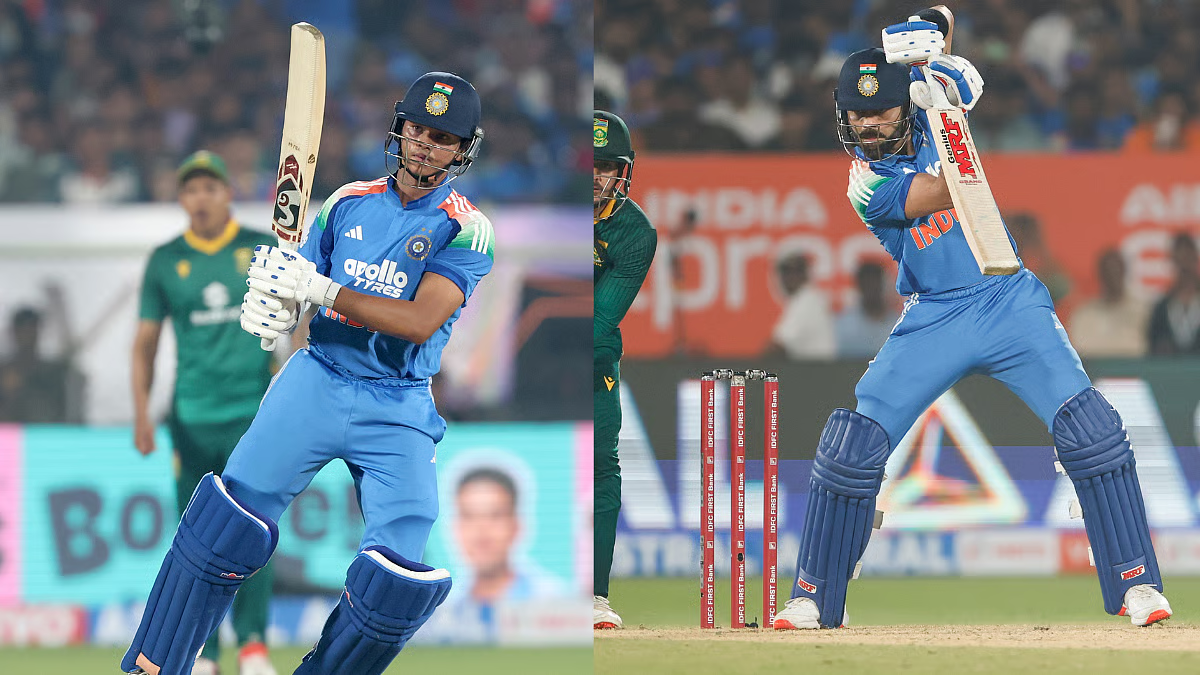
The South Africa national cricket team vs India national cricket team match scorecard would be incomplete without acknowledging the symphony of batting excellence orchestrated by India’s opening and middle-order combination. Chasing 271 proved to be more than a mere formality; it became a canvas upon which India’s batsmen painted masterstrokes of cricket artistry.
Yashasvi Jaiswal’s maiden ODI century represents one of the year’s most significant milestones for Indian cricket. The 23-year-old southpaw, playing only his fourth ODI since debuting against England earlier in the year, joined an exclusive club of batsmen possessing centuries across all three international formats. His approach was characteristically patient in the initial phase, taking time to establish himself at the crease before gradually shifting gears as the innings progressed.
Jaiswal’s partnership with Rohit Sharma yielded an unprecedented opening stand of 155 runs—a partnership that essentially decided the match’s outcome. Rohit, the stalwart of Indian cricket, contributed 75 runs off 73 balls, featuring seven fours and three sixes. More significantly, during this knock, Rohit surpassed the 20,000 international run milestone, becoming only the fourth Indian cricketer after Sachin Tendulkar, Virat Kohli, and Rahul Dravid to achieve this rare feat. The 37-year-old’s continued excellence in the format underscores his evolution as a modern cricketer capable of adapting to contemporary demands.
When Rohit departed after his half-century, caught off Keshav Maharaj’s left-arm spin, Virat Kohli arrived at the crease—not to steady an uncertain ship, but to accelerate India toward inevitable victory. Kohli’s unbeaten 65 came off a mere 45 balls, demonstrating the explosive potential that has made him a global icon. His six fours and three sixes epitomised controlled aggression, maintaining balance between risk and reward. Kohli’s approach signalled India’s intent to finish the series emphatically rather than merely secure victory.

Jaiswal, meanwhile, continued accumulating runs with increasing fluency. His maiden half-century arrived off 75 balls, after which he accelerated impressively. His century came off 111 balls in the 36th over, and thereafter, he continued striking boundaries—particularly against the shorter deliveries that South Africa desperately attempted to introduce for containment.
Record-Breaking Performances and Statistical Highlights
The South Africa national cricket team vs India national cricket team match scorecard is studded with notable statistical achievements that will be referenced in cricket histories for years to come.
Kuldeep Yadav’s Historic 4-Wicket Haul: Beyond the immediate match context, Kuldeep’s four wickets marked his ninth four-wicket haul in ODI cricket. More significantly, it established him as the Indian bowler with the most four-plus wicket hauls against a single opponent in ODI history. Among Indian spinners in the 50-over format, only a select few have matched such consistency and excellence.
Rohit Sharma’s 20,000 International Runs: The Indian captain’s achievement joins him with an incredibly exclusive group. Rohit’s longevity, adaptability, and consistency across all three formats have defined modern Indian cricket. At 37 years old, his continued pursuit of excellence sets an example for aspiring cricketers globally.
Yashasvi Jaiswal’s Triple Format Hundred: Achieving centuries in Tests, ODIs, and T20Is within a calendar year, and that too early in one’s international career, speaks volumes about Jaiswal’s talent and temperament. The left-hander’s growth trajectory suggests India has found a generational talent capable of shouldering responsibilities for the next decade.
Virat Kohli’s Series Dominance: Although he couldn’t reach three figures in the decider, Kohli’s series tally of 302 runs across three matches (with two centuries) crowned him Player of the Series. His 128th ODI half-century tied him even closer to cricket’s immortals, and his unbeaten 65 off 45 balls demonstrated his evolving batting philosophy in the modern era.
Match Summary: The Complete Narrative

The South Africa national cricket team vs India national cricket team match scorecard encapsulates a contest where India exhibited superiority across all departments. South Africa’s batting, despite de Kock’s heroics, lacked the collective firepower necessary to establish a commanding total. Their bowling, though possessing quality operators like Keshav Maharaj and Marco Jansen, couldn’t prevent India’s batsmen from orchestrating a clinical chase.
From India’s perspective, the victory assumed significance beyond mere statistics. Having lost the preceding Test series to South Africa (an away series whitewash), this ODI series victory provided psychological relief and demonstrated the team’s capability to respond to adversity with unwavering intent. The comprehensive nature of the victory—losing only one wicket while chasing 271—suggests a team at the peak of its collective prowess.
Key Match Statistics and Insights
Highest Partnership: Jaiswal-Rohit opening stand of 155 runs, crucial in determining the match’s trajectory.
Best Bowling Figures: Kuldeep Yadav’s 4/41, representing his fifth four-wicket haul against South Africa and ninth overall in ODIs.
Strike Rates: Kohli’s 144.44 SR dominated the latter stages, while Jaiswal’s 95.87 reflected a measured but productive approach.
Dew Factor: Visakhapatnam’s anticipated dew arrived later than expected, though it marginally assisted India’s chase, justifying KL Rahul’s decision to field first.
Player Performances Analysis
Yashasvi Jaiswal (India): At 116 not out, Jaiswal proved that youth and experience need not be mutually exclusive. His ability to pace an innings, accelerate when required, and maintain composure against quality bowling underscores his potential as a long-term asset to Indian cricket.
Rohit Sharma (India): The captain’s 75 off 73 balls demonstrated strategic batting. Rather than forcing the issue early, Rohit allowed Jaiswal to build momentum before setting the platform for Kohli’s assault.
Quinton de Kock (South Africa): Despite the team’s eventual collapse, de Kock’s 106 off 89 balls was a masterclass in T20-style cricket within the ODI format. His ability to construct an innings while maintaining aggression separates him from contemporary wicketkeeper-batsmen.
Kuldeep Yadav (India): Beyond his four wickets, Kuldeep’s ability to recognise match situations and adjust his bowling accordingly—mixing pace variations, flight, and length—represents the modern spinner’s evolution.
Venue: Dr YS Rajasekhara Reddy ACA-VDCA Cricket Stadium, Visakhapatnam
Visakhapatnam has emerged as one of India’s premier cricket venues, particularly for home ODI contests. The stadium’s capacity, crowd enthusiasm, and balanced pitch conditions have witnessed numerous memorable performances. Notably, the venue has historically favoured teams batting second, a trend that continued in this series decider. The coastal city’s dew factor, while inconsistent, generally supports fast bowlers during the opening phase and spinners during the middle overs—a pattern that played out precisely during the South Africa vs India match.
Series Context and Implications
The South Africa national cricket team vs India national cricket team match scorecard from the 3rd ODI must be understood within the broader context of India’s white-ball cricket strategy. With ODI World Cup considerations still relevant, series victories against top-ranked opponents provide valuable momentum and confidence. South Africa, despite this loss, remains a formidable Test nation and respectable ODI outfit, making India’s emphatic victory all the more significant.
Conclusion
India’s 9-wicket victory in the series decider, as reflected in the South Africa national cricket team vs India national cricket team match scorecard, sends a resounding message to cricket’s global fraternity. The Men in Blue are not merely a competitive force but a team capable of orchestrating comprehensive victories against elite opposition. Yashasvi Jaiswal’s emergence as a capable ODI opener, Rohit Sharma’s continued excellence, Virat Kohli’s enduring mastery, and Kuldeep Yadav’s spindle-like precision collectively suggest India’s future in white-ball cricket remains extraordinarily bright.
For South Africa, despite the defeat, the series—and particularly de Kock’s brilliant batting—provided positive indicators. However, the Proteas’ inability to maintain momentum once established and their collapse when a competitive position appeared achievable highlighted areas requiring attention.
The scorecard will fade from immediate memory, but the performances will echo through India’s cricket annals as a reminder of what excellence, unity, and tactical acumen can achieve.




Leave a Reply